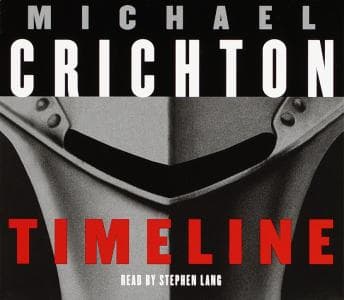

Denise and I have a rule about the lakefront walks: no talking about school, no talking about bills, and no pausing the audiobook to explain the plot to each other. That last rule got tested pretty hard during Timeline, because somewhere around hour six, when our historians are sprinting through a burning medieval village trying not to get crossbow bolts in their backs, she grabbed my arm and said, 'Wait, they went WHERE?' And I had to explain quantum foam and fourteenth-century France in the same sentence. That's the Crichton effect. He makes you feel like you understand physics right up until the moment you realize you absolutely do not.
I came into this one a little skeptical, honestly. I teach literature. I know what 'character development' means, and Crichton has never exactly been its champion. His people are usually delivery mechanisms for ideas - smart, capable, interchangeable vessels for getting you from one set-piece to the next. Timeline is no different. The archaeologist characters here - Chris Hughes, André Marek, Kate Erickson - are sketched quickly and you're expected to fill in the rest yourself. Marek is the medieval obsessive who was basically born in the wrong century, and that's the most fully realized interiority any of them gets. My students would call this lazy. I'd call it a feature, not a bug, for this particular kind of story.
Because what Crichton is actually doing - what he's always doing - is using genre fiction as a Trojan horse for nonfiction. The medieval history embedded in Timeline is genuinely rigorous. The descriptions of Castlegard, the siege warfare mechanics, the specific social architecture of fourteenth-century Dordogne - this is researched material wearing a thriller's clothes. There's a sequence where Marek explains why a knight's armor functioned the way it did, and it's more illuminating than half the textbooks I've assigned. This is why we still read the classics - and why we should read Crichton alongside them. He understood that story is the most efficient delivery system for information that humans have ever invented. Zora Neale Hurston understood this too - Their Eyes Were Watching God carries more anthropology and folklore than most academic surveys, and it does it without once feeling like homework.
What John Bedford Lloyd Gets Right (And Where He Plays It Safe)
Lloyd's narration is competent in a way that's both reassuring and occasionally frustrating. His baseline voice is warm and authoritative - exactly what you want for Crichton's expository passages, which can run long and dense. When the book is explaining quantum mechanics or trebuchet engineering, Lloyd keeps the pace measured without letting it go slack. That's harder than it sounds. The prose deserves to be savored in those moments, and he respects that.
Where he's less successful is in the action sequences. Crichton's battle scenes have a kinetic, almost cinematic energy on the page - arrows whistling, horses screaming, the chaos of a medieval siege rendered in sharp physical detail. Lloyd's delivery stays pretty even-keeled through all of it. The narrator understands that pause is punctuation, but he doesn't always understand that urgency is punctuation too. There's a hand-to-hand combat scene in the fortress that should feel desperate and claustrophobic, and Lloyd narrates it with roughly the same energy he uses for the corporate boardroom scenes in Arizona. That's a missed opportunity.
Character voices are differentiated but not dramatically so. Marek sounds slightly warmer than the others; the corporate villain ITC types get a cooler, clipped register. Functional. Not transformative. (I know I'm not supposed to use that word. You know what I mean.)
The Crichton Problem, Which Is Also the Crichton Gift
Here's the thing about Timeline that I keep turning over: it's a book that's deeply interested in authenticity - in what the past actually felt, smelled, sounded like - and yet it's structurally a theme park ride. The characters exist to move through medieval France so we can experience it vicariously. The plot mechanics (the quantum mirror, the ITC corporation, the ticking clock to get everyone home) are scaffolding, not architecture.
And I'm at peace with that. Not every book needs to be Middlemarch. (I say this as someone who literally listened to Middlemarch during a budget presentation and considers it one of the great decisions of my adult life.) Sometimes you need a book that grabs you by the collar at hour one and doesn't let go until the final chapter. Timeline is that book. The 15 hours went faster than most 10-hour audiobooks I've finished this year.
If you loved Jurassic Park, this is its spiritual successor - same DNA, different playground. The science is shakier, the stakes feel slightly smaller, but the medieval setting gives Crichton something the dinosaur island didn't: genuine historical texture to work with. Worth pausing the faculty meeting for. Worth the lakefront miles. Worth the confused look on your wife's face when you try to explain quantum foam at 7 AM.