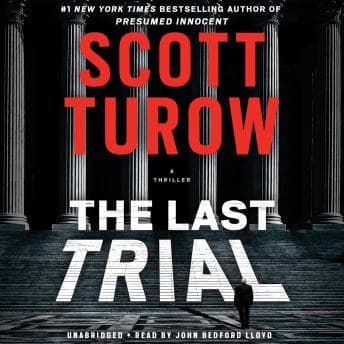

Sandy Stern is eighty-five years old, his body is failing him, and he's about to defend a friend accused of murder. Scott Turow doesn't ease you into this. He drops you into the weight of it—the courtroom, the cancer, the decades of friendship that might be built on lies.
I listened to this over a week of night shifts at the library. Empty stacks, fluorescent lights buzzing overhead, John Bedford Lloyd's voice in my ears as Stern methodically dismantles the prosecution's case while simultaneously questioning everything he thought he knew about Dr. Kiril Pafko. It's not horror, obviously, but there's a particular kind of dread here that I recognize. The slow realization that the monster might be the person you trusted most.
The Weight of a Voice
John Bedford Lloyd doesn't do flashy. He doesn't need to. His Stern is measured, deliberate—a man who knows exactly how much energy he has left and is spending it carefully. There's warmth there, but also this underlying exhaustion that never tips into melodrama. He just... carries it. Every objection, every sidebar, every moment Stern's heart condition flares up and you're suddenly aware that this might literally be his last trial.
The character differentiation is solid across the board. Dr. Innis McVie, Pinky, the various witnesses—Lloyd gives them enough distinction that you're never confused, but he never turns anyone into a caricature. The courtroom scenes have this rhythm to them, this ebb and flow of tension that Lloyd navigates beautifully. When the prosecution lands a blow, you feel it. When Stern pivots, there's genuine satisfaction.
(I will say—and this is minor—the pacing in the middle drags slightly. Turow loves his procedural detail, and Lloyd reads it all with the same gravitas, which means some of the denser legal maneuvering can feel a bit like homework. I bumped it to 1.25x for about an hour and didn't miss anything crucial.)
When Friendship Becomes Evidence
Here's the thing about legal thrillers: most of them are about the case. The puzzle pieces, the gotcha moments, the dramatic reveals. And The Last Trial has those—the insider trading, the fraud, the murder charge that hangs over everything like a storm cloud.
But Turow is doing something else here. He's writing about what it means to know someone for fifty years and realize you might never have known them at all. Stern's internal conflict isn't just professional—it's existential. How do you defend someone when every piece of evidence makes you question your own judgment? How do you maintain faith in a system when you've spent your entire career watching it fail?
The audiobook format actually enhances this. Lloyd's delivery during Stern's private moments of doubt—the quiet scenes with his family, the reflections on his late wife—has this intimacy that I'm not sure would hit the same on the page. You're inside his head, listening to him process, and it's uncomfortable in the best way.
The Rug Pull
I won't spoil it. But there's a moment—maybe two-thirds through—where everything shifts. Where the case you thought you understood becomes something else entirely. Lloyd handles this transition perfectly. Affair pulls a similar shift—you think you're reading one kind of story until Reacher uncovers what's actually happening. The pace quickens almost imperceptibly. Stern's voice gets slightly more urgent. And suddenly you're not just listening during your commute anymore. You're sitting in your car in the parking lot, engine off, waiting to find out what happens next.
(I definitely did this. Twice. My coworker thought I was having a crisis.)
The ending is bittersweet in a way that feels earned. This isn't a thriller that wraps everything up with a bow. It's a meditation on legacy, on truth, on what we owe the people we love versus what we owe the law. Heavy stuff, but Turow and Lloyd make it feel necessary rather than pretentious.
Who Should Listen (And Who Should Skip)
If you want explosions and car chases, skip this. If you want a fast-paced beach read, definitely skip this. But if you're the kind of person who finds courtroom procedure genuinely fascinating—who wants to understand not just what happened but why it matters—this is exceptional.
Commuters, this is your jam. The chapters are well-paced for drive times, and Lloyd's clear delivery means you won't miss crucial details even in traffic. Just be prepared for the occasional moment where you're so absorbed you almost miss your exit.
At nearly sixteen hours, it's a commitment. But for legal thriller fans? For people who grew up on Presumed Innocent and have been waiting for Turow to deliver something with that same weight? Worth every minute.
Stern's final trial might also be Turow's best work in years. And Lloyd makes sure you feel every moment of it.