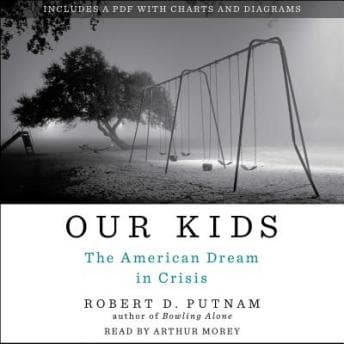

Everyone told me this was a depressing book. They weren't wrong, but they undersold what Putnam actually pulled off here.
I finished this one on a late Thursday night, sitting on the back porch with Ranger while Linda was already asleep. Couldn't do it during my usual windshield time - too much data, too many stories that demanded I actually sit with them instead of navigating I-35 traffic.
Port Clinton Isn't Just a Town, It's a Thesis
Here's what separates Putnam from most policy wonks writing about inequality: he starts with his own high school class of 1959 in Port Clinton, Ohio. Not as a gimmick, but as a baseline. He knew these kids - the rich ones, the poor ones, the ones whose dads worked at the local factory. And then he tracks what happened to their children and grandchildren. The contrast is brutal. In 1959, the class lines existed but they were permeable. By the time you get to the present-day Port Clinton kids he interviews, those lines might as well be concrete barriers topped with concertina wire.
What got me was the specificity. There's a kid named David - grew up in Port Clinton a generation later - bouncing between his divorced parents, essentially raising himself while surrounded by drugs and dysfunction. Then you get a kid from the same zip code whose parents are orchestrating every advantage: SAT prep, extracurriculars, networking connections before the kid's even old enough to drive. Putnam doesn't moralize about it. He just lays both lives side by side and lets you do the math.
I've seen this scenario play out in real life. Twenty-five years in the Army, I served alongside kids from every background you can imagine. Some of my best soldiers came from situations that would've broken most people. But I also watched how the ones without family support structures had to fight twice as hard for half the result. Putnam puts empirical muscle behind what I observed anecdotally, and that's where the book earns its weight.
The Data Doesn't Lie (But It Does Hurt)
Putnam alternates between these personal narratives and hard social science - income mobility statistics, education funding disparities, the collapse of community institutions he first identified in Bowling Alone. If you read that earlier book, Our Kids is essentially the sequel nobody wanted. Bowling Alone said we were losing social capital. Our Kids says here's what that loss actually costs when measured in human lives.
The chapter on family structure hit hard. Not because it's politically convenient for any side - Putnam is careful to avoid that trap - but because he demonstrates how the erosion of stable two-parent households correlates with basically every other metric of declining opportunity. He's not wagging his finger. He's showing you the data and then introducing you to a teenager living inside that data point. That same tension between institutional data and individual human cost runs through On Tyranny too - Snyder uses history the same way Putnam uses statistics, as scaffolding to hold up something that's ultimately about real people losing real ground.
Now, is this book perfect? No. Published in 2015, some of the economic data feels like it's describing a world that's shifted again. The gig economy, remote work, the pandemic - none of that's in here. And Putnam's policy prescriptions in the final chapters feel thin compared to the devastating 9 hours of diagnosis that preceded them. It's the classic academic problem: brilliant at identifying what's broken, a little vague on how to fix it. I wanted more operational specifics. Give me the five-paragraph order, not just the intelligence brief.
Arthur Morey Knows When to Get Out of the Way
Morey's narration is exactly right for this material. He reads with weight but doesn't oversell the emotional moments - and there are plenty that could've been turned into melodrama. When he's reading David's story, or the story of a single mom in Atlanta trying to hold things together, there's genuine warmth without theatrical grief. He treats these real people's stories with respect.
I listened at my usual 1.25x and it worked fine for the narrative sections, but I actually bumped back to 1.0x during the data-heavy passages. There's enough statistical content that you want to process it, not just hear it fly by.
Compared to something like Matthew Desmond's Evicted (another gut-punch social science book), Our Kids covers wider ground but with less immersive depth per story. Desmond lived with his subjects. Putnam interviewed his. Both approaches work, but they land differently. Putnam gives you the aerial view with enough ground-level detail to keep it human.
Who Needs This in Their Ears
Anyone who argues about politics at Thanksgiving dinner should listen to this first. Not because it'll change your mind - it might not - but because it'll arm you with actual evidence instead of cable news talking points. If you're a parent, parts of this will make you deeply uncomfortable regardless of your income bracket. If you served and came from a small town, parts of this will feel like someone wrote about your hometown.
Skip it if you want solutions more than diagnosis, or if a decade-old snapshot of American inequality feels too dated for your needs.
Ranger and I Sat With This One Awhile
Worth your time? Here's the debrief: Putnam wrote a book that made a retired colonel sit on his porch past midnight because he couldn't just turn it off and go to bed. The stories are real, the data backs them up, and Morey delivers it all without making you feel lectured. It's not a fun listen. It's an important one. And those are sometimes the books that stick longest.




![Steve Jobs [unabridged audiobook] audiobook cover](/_next/image?url=https%3A%2F%2Fcovers.audiobooks.com%2Fimages%2Fcovers%2Ffull%2F9788499923406.jpg&w=1920&q=75)