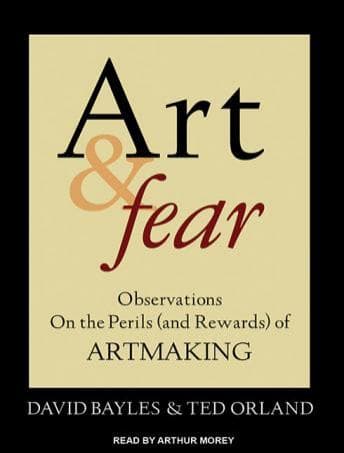

"Art is made by ordinary people."
I had to pause the audiobook when Arthur Morey delivered that line. I was walking the lakefront with Denise, and she looked over at me like I'd lost my mind. But that sentence—so simple, so quietly devastating—is exactly what every student who's ever told me "I'm just not creative" needs to hear. What every exhausted teacher grading their forty-seventh essay at midnight needs to remember.
Art & Fear is barely three hours long. I've assigned novels that take longer to summarize. But Bayles and Orland have done something remarkable here: they've written the book I wish someone had handed me in grad school, back when I was convinced that real artists were born with some mystical gift I clearly lacked.
The Voice That Understands the Pause
Arthur Morey narrates this like he's having a conversation with you at a coffee shop. Not performing. Not lecturing. Just... talking. His pacing is deliberate in the best way—he lets the ideas breathe. There's a section about how most art schools teach technique but never address the psychological warfare of actually making things, and Morey delivers it with this quiet intensity that made me want to take notes. (I was walking. I couldn't take notes. I replayed that section twice.)
I couldn't find much about Morey's background before this, but based on his AudioFile awards and what I'm hearing here, the man understands that pause is punctuation. He knows when to let a sentence land. For a book that's essentially philosophy about creative work, that restraint is everything. A more theatrical narrator would've killed it.
Why This Hits Different for Teachers
Look, here's the thing. I teach English to teenagers who've been told their entire lives that there's a "right" way to write an essay. Five paragraphs. Thesis statement. Topic sentences. And I enforce that structure because standardized tests exist and I need them to pass. But Bayles and Orland are writing about the cost of that kind of thinking—how the fear of making mistakes becomes the thing that stops us from making anything at all.
There's a famous story in here about a ceramics teacher who divided his class in two. One group would be graded on quantity—just make as many pots as possible. The other group would be graded on quality—make one perfect pot. Guess which group produced the best work? The quantity group. By a mile. Because they were actually making things, learning from failures, getting their hands dirty.
My students would hate this. They want the rubric. They want to know exactly what "A" looks like so they can reverse-engineer it. And I get it—I was the same way. But this book argues that the rubric is the enemy of the work. That the fear of imperfection is what keeps the pot from ever getting made.
(Don't tell my students I said that. I still need them to follow the rubric.)
The Spiritual Successor to "Bird by Bird"
If you loved Anne Lamott's Bird by Bird—and if you're the kind of person reading audiobook reviews about creativity books, you probably have—this is its quieter, more philosophical cousin. Lamott is funny and confessional and messy. Bayles and Orland are more like the wise professors who never raise their voices but somehow make you feel seen.
That same quiet authority—the kind that makes you lean in rather than tune out—is what drew me to Journey of Crazy Horse: A Lakota History, where the narrator treats the material with similar reverence.
The prose deserves to be savored. I listened at 1.0x because these authors chose their words carefully, and Morey respects that. There's no filler here. No padding. Every chapter is maybe ten minutes long and contains at least one idea that made me stop and think about my own creative work. (Yes, I count my podcast as creative work. All 47 listeners would agree.)
Who Should Listen (And Who Should Skip)
This is for anyone who makes things. Writers, painters, musicians, teachers, podcasters with tiny audiences. It's for the person who's been "working on" a novel for five years. It's for my colleague who keeps saying she'll start painting again "when she has more time." It's for the student who turned in a brilliant short story and then never wrote another one because she was terrified of not being brilliant twice.
Skip it if you want a how-to manual. There's no advice about brushstrokes or sentence structure or marketing your work. This is about the internal game—the fear, the doubt, the voice that says you're not a real artist.
I finished it on a Tuesday morning, walking past the Shedd Aquarium, and immediately texted my wife: "I need to record more podcast episodes." She texted back: "You say that every month." She's not wrong. But this time I actually did it.
Three hours. Worth pausing the faculty meeting for. Worth pausing everything for.