
I'm going to start with a complaint. My husband Carlos asked me why I was sitting in the driveway for twenty extra minutes after my shift ended, and I had to explain that I couldn't just STOP listening in the middle of a recon team getting surrounded by NVA forces. The man looked at me like I'd lost my mind. Maybe I have.
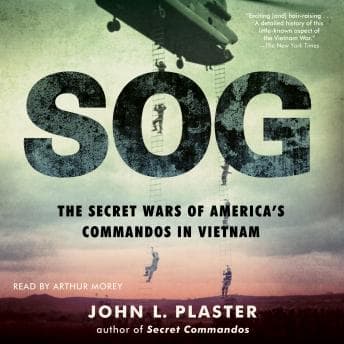
I picked up SOG because I needed something to keep me awake during those brutal 3 AM charting sessions when the unit goes quiet. What I got instead was a 14-hour education in a war I thought I understood but absolutely did not.
The Slow Build That Pays Off
Fair warning—this book takes its time at the start. Plaster spends the first chunk laying out the strategic context, explaining why SOG existed, how it operated, the politics behind keeping it classified. I'll be honest, during the first hour I was like "get to the missions already." But here's the thing: that groundwork matters. Once you understand what these men were walking into, the mission accounts hit different.
And then it clicks. And then you can't stop.
The missions themselves are... look, I've worked trauma for 15 years. I've seen gunshot wounds, stabbings, car accidents that would give you nightmares. But listening to these accounts of six-man recon teams operating behind enemy lines, sometimes surrounded by hundreds of NVA soldiers, calling in airstrikes on their own positions because there was no other option—that's a different kind of intensity. These weren't Hollywood scenarios. This was real. These were real men. Many of them didn't come home.
Arthur Morey Gets It Right
The narration here is exactly what this material needs. Arthur Morey doesn't try to dramatize or add Hollywood flair—he reads it straight, clear, respectful. And honestly? That's perfect. The stories are dramatic enough on their own. You don't need someone hamming it up when you're listening to an account of a Medal of Honor action.
Morey's delivery is steady and engaging without being monotone. He keeps you locked in during the tense moments but doesn't lose you during the more technical sections about equipment and tactics. For a 14-hour listen, that consistency matters. I never found myself rewinding because I zoned out—and that's saying something when I'm listening at 4 AM after dealing with a full trauma bay.
What Hit Me Hardest
I wasn't expecting to get emotional. I'm a night shift nurse—we develop pretty thick skin out of necessity. But there's this thing that happens when you listen to someone describe carrying a wounded teammate through jungle for hours, or calling in their own coordinates for an airstrike, or the simple fact that SOG had a 100% casualty rate. One hundred percent. Every single operator was either killed or wounded at some point.
As someone who's actually worked a code, who's held a patient's hand while we couldn't save them, who's had to call families at 2 AM—there's something about the matter-of-fact way Plaster describes these losses that got to me. No melodrama. Just the facts of what happened and who was lost. Carlos definitely caught me wiping my eyes in the driveway more than once. I blamed allergies. He didn't believe me.
Plaster Was There—And You Can Tell
What separates this from other Vietnam books is that Plaster was there. Three tours with SOG. This isn't a journalist reconstructing events from interviews—this is a man who ran those missions, who knew those operators, who lost friends in that jungle. You can feel that authenticity in every chapter.
The medical details are accurate. Finally. (Sorry, occupational hazard—I notice these things.) When he describes wounds, triage decisions, medevac procedures, it tracks with what I know. That might seem like a small thing, but it builds trust. If he's getting the medical stuff right, I believe him on the tactical stuff too.
Who This Is For (And Who Should Skip It)
Military history buffs—obvious yes. Vietnam War scholars—absolutely. But honestly? Anyone who wants to understand what covert operations actually looked like before Call of Duty made it all seem like a video game. If you want that same gut-punch of historical reality about American military history, Bury My Heart at Wounded Knee delivers it from a completely different perspective—and it's just as unflinching about what actually happened. This is the real thing. It's messy and terrifying and sometimes the good guys don't make it.
If you're sensitive to graphic descriptions of combat and violence, skip this one. Plaster doesn't sensationalize, but he doesn't sanitize either. War is brutal. He shows you that.
Shift Change
Night shift approved. This one kept me alert, kept me thinking, and gave me a whole new appreciation for a piece of history that was literally classified for decades. My mom would probably tell me I should've been reading medical journals instead, but she can deal with it.








![Steve Jobs [unabridged audiobook] audiobook cover](/_next/image?url=https%3A%2F%2Fcovers.audiobooks.com%2Fimages%2Fcovers%2Ffull%2F9788499923406.jpg&w=1920&q=75)