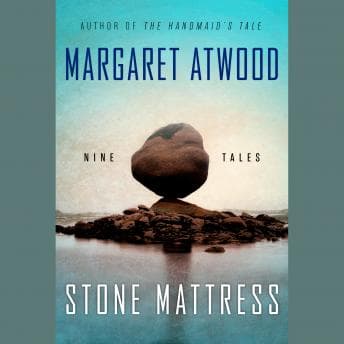

Margaret Atwood reading her own work is like having Hemingway pour you a whiskey and explain what he really meant. You don't question it. You just sit there and listen.
I finished the title story—"Stone Mattress"—during a particularly tedious budget meeting last week. Principal Martinez was discussing copier allocations. Atwood was describing a woman contemplating murder on an Arctic cruise ship using a 1.9 billion-year-old fossil. Guess which one held my attention.
When the Author Becomes the Narrator
I've been teaching literature long enough to know that authors reading their own work is a gamble. Sometimes you get magic. Sometimes you get a monotone disaster that makes you appreciate why actors exist. Atwood? She knows exactly what she wrote and exactly how it should land. Her delivery of "Stone Mattress" is measured, almost conversational, like she's telling you a particularly dark secret over tea. The pacing is deliberate in the best way—she trusts the words, doesn't rush the reveals.
But here's the thing about this collection: it's not just Atwood behind the microphone. Seven narrators tackle nine stories, and the variety actually works. Lorna Raver handles the opening trilogy ("Alphinland," "Revenant" via Mark Bramhall, and "Torching the Dusties") with this low, warm voice that fits the older protagonists perfectly. She sounds like someone who's lived through things. My students would probably say she sounds like their grandmother, and I mean that as high praise.
Arthur Morey takes on "Dark Lady" and "The Dead Hand Loves You," and his deliberate pronunciation serves the gothic undertones well. He's not rushing through the horror elements—he's letting them breathe. Emily Rankin only gets the shortest piece, "Lusus Naturae," but she nails the innocence-turned-monstrous arc. There's something genuinely unsettling about her delivery that stayed with me during my lakefront walk the next morning.
The Atwood Trick: Making You Laugh Before the Knife Twists
This is what I tell my AP Lit students about Atwood—she's never just doing one thing. These stories are funny. Genuinely, darkly funny. And then suddenly you're reading about aging, mortality, revenge, and the particular cruelty humans are capable of, and you realize she's been setting you up the whole time.
"Torching the Dusties" is a perfect example. An elderly woman in a retirement home sees little people due to Charles Bonnet syndrome. Sounds whimsical, right? Then a populist mob shows up to literally burn down the building. (I taught this story last semester. My students thought it was too on-the-nose. I told them that's because they haven't been paying attention to the news.)
The three connected stories—"Alphinland," "Revenant," and "The Dead Hand Loves You"—form this loose web about writers and artists and their romantic entanglements. If you loved Alias Grace, this is its spiritual successor in terms of psychological complexity. That same exploration of how we construct our own narratives shows up in The Great Gatsby, though Fitzgerald's characters are considerably less self-aware about it. Atwood gets the messiness of creative people, the way old relationships calcify into resentment, the way we mythologize our own pasts.
Seven Voices, Nine Stories
I'll be honest—I usually prefer a single narrator for short story collections. The consistency helps. But here, the different voices actually mirror what Atwood's doing on the page. Each story has its own tone, its own register, and the narrators match that. Rob Delaney (yes, that Rob Delaney) handles "The Freeze-Dried Groom" with appropriate bewilderment. Bernadette Dunne brings warmth to the Zenia story that fans of The Robber Bride will appreciate.
The production is clean throughout. No weird volume shifts between narrators, no audio artifacts. Someone at the studio knew what they were doing.
Your Syllabus Check
This is Atwood at her most playful and her most savage, often in the same paragraph. If you want straightforward genre fiction, skip this one. If you want an author who respects your intelligence enough to leave things unsaid, who trusts you to catch the references and feel the implications—this is your collection.
My students would hate this. I love it.
The prose deserves to be savored at 1.0x, and yes, I know I'm ancient for saying that. But when Atwood describes a stromatolite as a potential murder weapon with the same clinical precision she'd use for a recipe, you want to hear every syllable.
Worth pausing the faculty meeting for. Worth the credit. Worth your time.