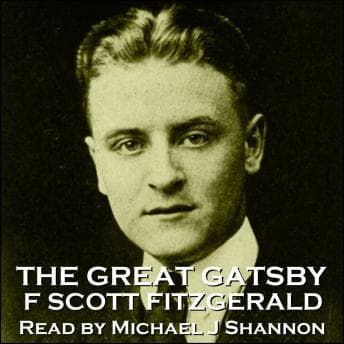

Look, I've taught The Great Gatsby probably forty times. Forty. I've watched teenagers roll their eyes at the green light, listened to them ask why Daisy doesn't just leave Tom, graded essays that somehow miss the entire point of Nick's unreliability. I know this book the way I know my own apartment - every creaky floorboard, every draft from the windows.
So why did Michael J Shannon's narration make me feel like I was hearing it wrong?
The Reporter in the Room
Here's the thing about Nick Carraway: he's supposed to be our eyes and ears. He's the guy at the party who's watching everyone else have the time of their lives while nursing his one drink in the corner. Shannon gets that. His delivery is clean, neutral, almost journalistic - which, on paper, makes total sense. Nick literally tells us he's "inclined to reserve all judgments." Shannon takes that and runs with it.
But - and this is where I spent three lakefront walks arguing with myself - does that neutrality serve the story or flatten it?
I kept waiting for the emotional undercurrent. That moment when Nick describes Gatsby's smile, "one of those rare smiles with a quality of eternal reassurance in it" - that should hit different. It should make you understand why everyone falls under Gatsby's spell. Shannon reads it clearly. Correctly. But I didn't feel the pull.
My wife Denise, who was walking beside me during the party scenes, actually asked if I was listening to a documentary. (She wasn't wrong.)
When Clarity Becomes Distance
At under three hours, this is a quick listen. And Shannon's pacing is steady - no weird pauses, no stumbling over Fitzgerald's longer sentences. The production is clean. If you're a student who needs to absorb the plot before tomorrow's quiz, this'll do the job.
But Fitzgerald's prose deserves to be savored. Those sentences - "So we beat on, boats against the current, borne back ceaselessly into the past" - they're not just plot delivery devices. They're poetry. And poetry needs breath. It needs someone who understands that the pause is punctuation.
Shannon doesn't give us much of that. He's reporting the facts of Gatsby's tragedy without letting us feel the weight of it. Tom and Daisy sound pretty much like Nick. Gatsby sounds like Nick. Jordan sounds like Nick. It's all one voice, one register, one temperature.
I found myself mentally adding the emotional coloring that wasn't there. Which, honestly? That's extra work I wasn't expecting to do.
Who Should Listen (And Who Should Skip)
I'm being hard on this recording, and I should be fair. If you've never read Gatsby and you want a straightforward, no-frills introduction to the text, Shannon delivers exactly that. His neutrality means you're getting the words without someone else's interpretation layered on top. There's something to be said for that - letting Fitzgerald speak for himself.
And if you're the type who listens at 1.5x or 2x speed (my students, I'm looking at you), this narration probably works fine. It's clear enough to survive acceleration.
But if you're like me - if you believe narration is performance art, if you want to hear someone wrestle with Fitzgerald's gorgeous, melancholy sentences - this might leave you cold. Skip this version and look for something with more vocal range. I've heard the Jake Gyllenhaal version exists, and apparently it's more dynamic. Might need to give that one a try.
Final Grade
This is still The Great Gatsby. It's still one of the most perfectly constructed American novels ever written. The tragedy of Gatsby, the moral emptiness of the Buchanans, Nick's complicity in all of it - that's all here. Shannon doesn't ruin it.
But he doesn't elevate it either.
I finished this during a particularly tedious faculty meeting (sorry, Principal Martinez, your budget presentation was surely fascinating), and I found myself wishing for more. More vocal differentiation. More emotional stakes. More recognition that this isn't just a story about rich people behaving badly in the 1920s - it's a story about the American Dream eating itself alive.
My students would probably think this narration is fine. They'd listen, pass the quiz, move on. But this is why we still read the classics - because they deserve more than fine. Same goes for Nightingale: A Novel - another story that needs a narrator who gets the emotional stakes beneath the surface. Fitzgerald wasn't just writing a novel. He was writing a eulogy for an entire generation's illusions.
Shannon gives us the words. I wanted the music.