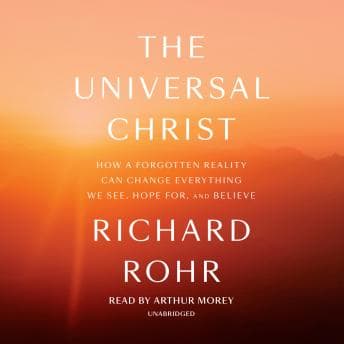

Richard Rohr is the kind of theologian who makes you feel like you've been reading the wrong footnotes your whole life. Not wrong in a shaming way — wrong in the way you realize you've been eating plain oatmeal when the full breakfast was sitting right there.
I finished this one on a long lakefront walk with Denise last Saturday. She was listening to something else, we had our earbuds in, doing that comfortable parallel-play thing married people do after 22 years. And I kept stopping to pull one earbud out and say things like, "Okay but listen to this—" She was very patient. She usually is.
What Rohr Is Actually Arguing (And Why It Matters)
Let's talk about what Rohr is really saying, because the title sounds like it could be either a profound theological intervention or an airport bookstore impulse buy. It's the former. The argument, stripped down: most Western Christianity spent centuries obsessing over the historical Jesus — the 33-year human life — while largely ignoring the Christ principle, which Rohr reads as a cosmic pattern of death and resurrection woven into the fabric of creation itself. "God loves things by becoming them" is the line that stopped me cold somewhere around the second hour. It's the kind of sentence that sounds simple until you sit with it and realize it's doing enormous work.
Rohr draws on Paul, on the Gospel of John, on Teilhard de Chardin, on Bonaventure — and he does it without the academic throat-clearing that usually accompanies this kind of synthesis. This is where I kept thinking about my students. I teach Emerson and Whitman every spring, and the "divinity in all things" current runs through American literature like an underground river. Rohr is giving that current a theological name and a historical address. If you loved Walden and always suspected Thoreau was doing theology without a license, this is its spiritual successor. George MacDonald was doing something similar a century before Thoreau — wrestling divinity into plain language without the institutional permission slip — and his Unspoken Sermons sits in the same quiet lineage Rohr is drawing from here.
The book isn't without its challenges. Rohr is a Franciscan friar with a contemplative practice, and some of his moves require you to hold paradox rather than resolve it. That's not a weakness — but readers who want clean doctrinal arguments will find him frustrating. He's not building a case so much as clearing ground.
Arthur Morey Earns His Three AudioFile Awards Here
I'll be honest: the research on this narrator was thin when I came in, mostly enthusiastic but vague. Three AudioFile "Best Of" awards, though — that's not nothing. And after nearly nine hours, I understand it.
Morey's voice has a quality I'd describe as earned gravity. Not somber, not performatively reverent — the way some narrators do religious material like they're reading at a state funeral. He reads Rohr's denser theological passages at a pace that actually lets the ideas land. When Rohr pivots from scholarly argument to something more personal and confessional, Morey finds that shift without announcing it. The narrator understands that pause is punctuation. There's a moment somewhere in the middle section where Rohr writes about the cross as a pattern rather than a transaction — I had to stop walking. Whether that was the prose or the delivery, I genuinely couldn't separate them. That's the mark.
No audio issues worth noting. Clean production, no distractions. The 8h 46m runtime feels appropriate — not padded, not rushed. This is a book that needs room.
Who Should Put This In Their Ears (And Who Shouldn't)
If you grew up religious and left, or stayed and felt vaguely unsatisfied, or never had a tradition and wondered what you were missing — this is worth your nine hours. If you're a reader of Whitman, Emerson, Teilhard, or Thomas Merton, Rohr is in direct conversation with all of them and will feel like a long-overdue introduction.
If you want biblical literalism defended or a traditional Christology reinforced, Rohr will frustrate you before the first chapter ends. He's not interested in that argument.
My students would hate this. Not because it's bad — because it asks you to hold ambiguity without flinching, and that's the hardest thing to teach a seventeen-year-old. Or, frankly, most adults.
Worth pausing the faculty meeting for. Worth pausing most things for, actually.