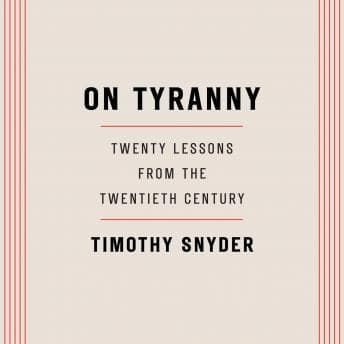

Everyone told me this book would make me angry. They were wrong. It made me think.
I finished this one during a late-night security audit at a client's office - just me, cold coffee, and Snyder's voice cutting through the fluorescent hum. Two hours. That's it. Shorter than most briefings I sat through in my Army career. But pound for pound? More actionable intelligence than a stack of classified reports.
A Historian's Field Manual
Here's what I didn't expect: Snyder structures this thing like a tactical manual. Twenty lessons, each one tight and direct. No academic meandering. Lesson 1: "Do not obey in advance." Lesson 6: "Be wary of paramilitaries." Lesson 10: "Believe in truth." The man writes like he's briefing troops before a deployment, not lecturing undergrads.
I've seen this scenario play out in real life - the slow creep of authority, the way people convince themselves that compliance is just being practical. Snyder draws from Weimar Germany, from Soviet occupation, from places where democracies died not with a bang but with a series of small surrenders. He's not being dramatic. He's being historical. There's a difference.
Snyder's a Yale professor who's spent decades studying how fascism actually happens - not the Hollywood version, but the mundane bureaucratic version. The version where ordinary people just... go along. That's the part that got under my skin.
Why Author-Narrated Works Here
Snyder reads his own work, and honestly? It's the right call. No actor trying to add drama where drama isn't needed. His delivery is measured, almost clinical at times - which fits the material. You're not being sold anything. You're being informed.
No music, no sound effects, no production tricks. Just a man who knows his subject speaking directly into your ears. At under two hours, the brevity is a feature, not a bug. Every lesson lands because there's no filler. I listened at my usual 1.25x and it held up fine - Snyder's pacing is already efficient.
One thing I'll note: this isn't a performance. If you want a narrator who delivers theatrical flourishes, look elsewhere. Snyder sounds like what he is - a professor who's genuinely worried and wants you to understand why.
Where It Lost Me (Briefly)
Look, I'm a conservative guy. Spent 25 years serving a country I believe in. Some of Snyder's political framing - and let's be honest, you can guess which direction he's aiming - made me bristle. But here's the thing: the historical lessons themselves are ideology-agnostic. Authoritarianism doesn't care about your party affiliation. It just needs people who won't resist. That institutional capture dynamic gets dissected from a different angle in WOKE, INC., though Ramaswamy's focus is corporate rather than governmental.
I found myself mentally arguing with Snyder on some points while completely agreeing on others. That's not a weakness of the book. That's the point. He wants you engaged, not passive.
Who Needs This Intel (And Who Doesn't)
If you've ever wondered how educated, civilized societies slide into darkness - and you want practical lessons, not hand-wringing - this delivers. Especially useful for anyone in leadership positions (corporate, military, civic) who needs to recognize warning signs before they become crises.
Skip it if you want comfort. Snyder isn't here to reassure you that "it can't happen here." He's here to explain exactly how it can, and what individuals did - or didn't do - to stop it.
Ranger slept through most of this one, which tracks. No explosions. No gunfire. Just uncomfortable truths delivered without apology.
Cooper Out
Under two hours. Twenty concrete lessons. No wasted words. Snyder treats you like an adult who can handle historical reality without it being sugarcoated. Whether you agree with his politics or not, the underlying message is sound: democracy requires active participation, not passive consumption.
I've added this to my recommended reading list for new consultants. Not because I agree with everything in it - I don't - but because understanding how institutions fail is part of understanding how to protect them. That's security work at its most fundamental level.
Worth a credit? At this length, wait for a sale or grab it on a streaming service. The content is solid, but you'll finish it in one commute. Borrow it, absorb it, then decide if you need it on your shelf.