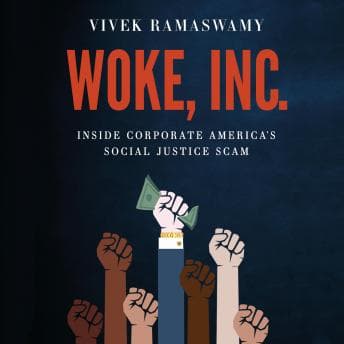

I have a strict rule about business books. I treat them like unassigned summer reading—I ignore them. Why? Because I hear enough empty buzzwords in our Monday morning faculty meetings. "Synergy." "Stakeholder engagement." "Paradigm shift." (Principal Martinez, I love you, but please stop saying "pivot.")
I picked this up mostly out of spite. Or curiosity. One of my AP English students wouldn't stop talking about it, and I figured I should probably know what the kids are arguing about before they start writing their college essays on it.
So here I am. Listening to a biotech CEO talk about social justice scams while I grade fifty terrible essays on The Great Gatsby at midnight.
The Smartest Kid in the Room Syndrome
Let's talk about the voice first. Ramaswamy narrates this himself. Usually, I tell people that unless you are Neil Gaiman or reading your own memoir about growing up in a cult, stay away from the microphone. Leave it to the actors.
But here? It actually makes sense.
Ramaswamy sounds exactly like what he is—a guy who debated his way through Harvard and Yale and won. He's sharp. He's fast. He's incredibly articulate. But he's also got that debate-team energy where he's trying to crush you with logic at 100 miles per hour.
(I actually had to check if I bumped the speed to 1.25x. I didn't. He just talks like that.)
It works for the material because the book is essentially one long, passionate argument. If a professional narrator read this, it might've sounded dry. With Vivek, you can hear the chip on his shoulder. You can hear the urgency. It keeps you awake, even when he gets into the weeds of asset management and legal theory.
Corporate America as Unreliable Narrator
Here's the thing that actually hooked me—and don't tell the business department I said this. This isn't really a business book. It's a critique of storytelling.
As an English teacher, my whole job is teaching kids to spot when a narrator is unreliable. Ramaswamy is basically arguing that Corporate America is the ultimate Unreliable Narrator. They tell us a story—"We care about the environment! We care about justice!"—while the subtext is just "Buy our sneakers."
He calls it "woke capitalism." I call it "performative fiction."
There were moments walking along the lakefront where I found myself nodding, not necessarily at the politics (which are pretty specific and definitely polarizing), but at the cynicism regarding corporate motives. Being Mortal tackles a different kind of institutional dishonesty—how hospitals hide behind medical jargon instead of having honest conversations about death. When Ramaswamy breaks down how companies use social causes as a smokescreen to distract from their actual business practices? Yeah. That tracks. It reminds me of students who suddenly care deeply about "community service" the week before applications are due.
The Sections Where I Washed the Same Plate Three Times
Yes, it drags.
There are sections where the "lawyer" side of him takes over. We get deep into SEC regulations and employment law. I'll be honest—I zoned out. I was listening while doing the dishes, and I realized I'd washed the same plate for three minutes because my brain just glossed over a section on stakeholder theory.
It's dense. This isn't a "pop in one ear while you grocery shop" kind of book. It requires active listening. If you're looking for a light memoir or a standard "how to get rich" guide, this isn't it. Though if you do want the "get rich" playbook, Automatic Millionaire delivers exactly that—no political sparring required. This one's a polemic. It wants to fight you.
Who's Going to Love This (And Who Should Run)
If you're skeptical of corporate virtue signaling—from either side of the aisle—and you don't mind a narrator who argues like he's still in moot court, you'll find plenty to chew on here. Skip it if you want something relaxing, or if debate-team energy makes you want to throw things.
Mr. Williams Puts Down His Red Pen
Did I agree with everything? No. (My politics are a bit more... let's say, "Chicago Teachers Union" than his.) But did it make me think? Absolutely.
Ramaswamy is a provocateur. He knows exactly what buttons he's pushing. The narration is crisp, the argument is structured like a legal brief, and even if you hate his conclusions, you have to respect the hustle of the rhetoric.
Just maybe don't listen to it right before bed. It's got too much caffeine in its veins.