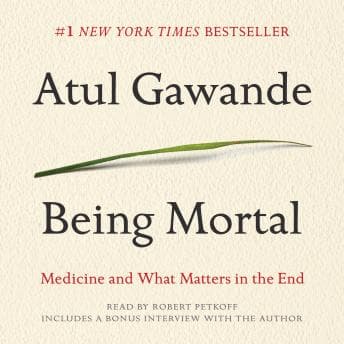

Okay, so here's the thing. I started this audiobook on a Monday morning commute thinking it'd be another medical nonfiction - interesting but detached, you know? The kind where a doctor tells you fascinating things about the human body and you nod along while half-asleep. By Wednesday, I was crying on the Caltrain. Like, actual tears. The guy next to me definitely noticed.
Being Mortal wrecked me in the best possible way.
Atul Gawande isn't just writing about death and aging - he's basically debugging our entire healthcare system's approach to mortality. And as someone who spends her days tracking down why distributed systems fail, I couldn't help but see the parallels. We've optimized medicine for the wrong metrics. We're measuring uptime when we should be measuring quality of service. (Yes, I'm making death into a tech metaphor. Kevin would be so proud.)
The book follows Gawande as he examines how we've medicalized the end of life to the point where we've forgotten what living actually means. He shares stories of his own patients, his father's decline, and these incredible examples of nursing homes and hospice programs that actually get it right. The research is solid - this isn't some fluffy self-help thing - but it's wrapped in storytelling that hits you right in the chest.
Robert Petkoff narrates, and honestly? He nailed it. I don't know much about him beyond the fact that he's an Audie Award winner, but his pacing is impeccable. He knows when to slow down for the heavy moments and when to keep things moving through the more clinical sections. There's this emotional weight in his delivery that never tips into melodrama - which is impressive given the subject matter. Could've easily gone saccharine. Didn't. The first-person sections where Gawande is reflecting on his own experiences come across super authentic, like you're actually having a conversation with the guy.
Now, is this a 6AM zombie-mode audiobook? Honestly... mostly yes, but with caveats. The narrative is clear enough that you won't lose the thread if your brain is running at 60% capacity. But there are chapters - particularly the ones about Gawande's father - where you'll want to actually pay attention. I found myself rewinding a few sections not because I was confused, but because I wanted to sit with them longer. That's rare for me.
The ROI on this audiobook is weird to calculate because it's not giving you productivity hacks or business frameworks. It's giving you something harder to quantify - a completely different way of thinking about what a good life looks like, especially at the end. Gawande argues that the question isn't "how do we help people live longer" but "how do we help people live better with the time they have." And he backs it up with actual examples of programs and approaches that work.
I finished this in about 4 commutes (it's 9 hours, and I bumped it to 1.5x for some of the more familiar medical background sections). The chapters on hospice care and the concept of "assisted living done right" were genuinely eye-opening. Like, I called my mom afterward. We had A Conversation. It was uncomfortable and necessary and I'm glad I did it.
Here's who should skip this: if you're going through something heavy right now - recent loss, a family member's illness - maybe wait. This isn't exploitative or gratuitously sad, but it doesn't shy away from the reality of decline and death either. Gawande describes procedures, difficult conversations, the slow erosion of independence. It's compassionate but unflinching. Who should listen? Anyone who's ever sat in a hospital waiting room wondering if the doctors were asking the right questions. Anyone with aging parents. Anyone who wants to think about this stuff before they have to.
Also, if you need your nonfiction to move at thriller pace, this might feel slow in places. It's not. It's deliberate. But I could see impatient listeners getting antsy during some of the historical context sections.
For everyone else though? This is basically The Checklist Manifesto but for dying well. Game does a similar thing with social dynamics—takes something messy and human and finds the underlying systems. (That's a compliment - I loved Checklist Manifesto.) Gawande takes a massive, terrifying topic and breaks it down into something you can actually think about and act on. He's not telling you death is beautiful or that you should embrace it with open arms. He's saying: here's how we're screwing this up, here's what better looks like, and here's how to have the conversations that matter.
Perfect for: train, long drives, any situation where you have space to think. Skip for: gym (too contemplative), background listening while coding (you'll miss the important stuff).
Bottom Line: Worth your commute. Bring tissues.








![Steve Jobs [unabridged audiobook] audiobook cover](/_next/image?url=https%3A%2F%2Fcovers.audiobooks.com%2Fimages%2Fcovers%2Ffull%2F9788499923406.jpg&w=1920&q=75)