
A daughter remembering her father shouldn't make you cry this hard.
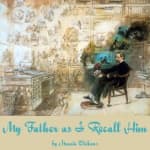
I was finishing up a logo revision at 2 AM, Frida curled on my keyboard like she owns it, when Mamie Dickens started describing how her father would read his own work aloud to the family. The way she talks about watching his face change as he inhabited each character - I had to pause. Because suddenly I was back in my abuela's living room, watching her face during the dramatic moments of her telenovelas, and I just... couldn't.
When Love Becomes Archive
This isn't a biography in any traditional sense. It's two hours of a woman trying to preserve the texture of someone she loved. Mamie doesn't give us Charles Dickens the Literary Giant. She gives us the man who insisted on specific flowers in specific arrangements. The father who organized elaborate theatrical productions at home. The person who was so methodical about his writing routine that she could predict his moods by his footsteps on the stairs.
What got me - and I mean genuinely got me, not performative book-reviewer got me - is how she writes around the painful parts. His separation from her mother? Barely mentioned. The complicated family dynamics? Glossed over with Victorian grace. But you feel the weight of what she's not saying. There's this moment where she describes his restlessness in his final years, and the restraint in her prose is almost unbearable. She loved him so completely that she couldn't bear to show us his flaws, and somehow that restraint says more than any tell-all ever could. Second Wife had that same quality of love complicated by what goes unsaid, though in a completely different context.
The "Various Readers" Situation
Okay, I need to be honest here. The production lists "Various Readers" and I genuinely couldn't find specifics on who they are or how they divide the material. This is clearly a volunteer production - probably from LibriVox or similar - and it shows. The audio quality shifts between sections. Some readers bring genuine warmth to Mamie's words; others feel like they're reading for a school assignment.
At two hours and nine minutes, though? It's a commitment you can make in a single afternoon. I listened straight through while working, and the inconsistency became almost... appropriate? Like passing a story between family members at a dinner table. Not everyone tells it the same way, but the love underneath stays constant.
If you need polished, professional narration, this might frustrate you. I'm usually picky about flat delivery, but something about the sincerity here made me forgive a lot.
The Specific Ache of Inherited Memory
Mamie was in her late forties when she wrote this, sixteen years after her father's death. And you can feel that specific grief - the one that's no longer raw but has settled into your bones. She writes about small things. The way he walked. His handwriting. How he'd suddenly burst into song.
There's a passage about his death that I won't spoil, but - my heart. MY HEART. She describes the ordinary morning that became the worst day of her life with such quiet precision. No melodrama. Just the facts of losing someone who was the center of your universe.
Abuela would have loved this one. She always said the best stories are the ones people tell about the people they've lost. Not the grand narratives, but the small remembrances. The way someone laughed. The foods they loved. The habits that drove you crazy until suddenly you'd give anything to be annoyed by them again.
Who This Is For (And Who Should Skip)
If you want Dickens scholarship or literary analysis, look elsewhere. This is a daughter's love letter, not a critical examination. If you're here for audiobook production values, the volunteer reader situation might be a dealbreaker.
But if you've ever lost someone and wished you could just... bottle the small moments? If you understand that grief isn't always dramatic but sometimes just the quiet accumulation of "I wish I could tell them about this"? This book felt like sitting with someone who understands that specific loneliness.
Para Mi Abuela, Wherever She Is
It's short. It's imperfect. The production quality is what it is. But at 1.0x speed on a quiet night, with cats who judge your tears and a heart that still misses someone who told stories in a living room in San Antonio - this hit exactly right.
Sometimes the most powerful thing isn't craft. It's just someone saying: here's who my father was. Here's what I remember. Here's what I don't want the world to forget.
I didn't ugly-cry. But I did that thing where you just... sit in the silence after it ends. Thinking about the people you'd write books about, if you could.