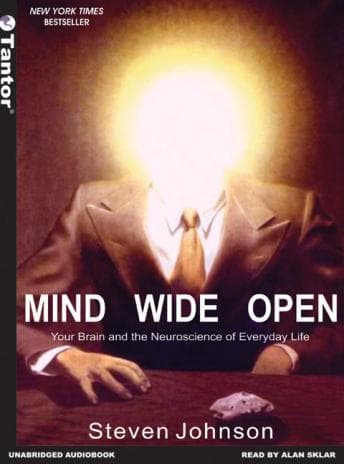

Everyone keeps telling me this book is "transformative" and "life-changing" and honestly? It's a solid neuroscience primer that got me through four commutes and made me feel smarter about why I can't remember Kevin's grocery lists but can recall the exact error message from a production outage six months ago. That's not life-changing. That's just... useful. And useful is pretty great.
Your Brain Is Basically a Microservices Architecture
Steven Johnson's central thesis here is one that hit home for me as a systems engineer: your brain isn't one unified "you" - it's a collection of semi-autonomous modules running in parallel, sometimes cooperating, sometimes fighting for resources, occasionally throwing exceptions that manifest as, say, smiling inappropriately when someone tells you something terrible. Johnson uses himself as a guinea pig throughout - getting fMRI scans, doing neurofeedback sessions where he literally controls a video game with his brain waves, taking attention tests. The experiential stuff is where the book shines. When he describes lying inside the fMRI machine and watching his own amygdala light up in response to fear stimuli, you get something textbooks don't give you: the visceral weirdness of watching your own threat-detection system fire in real time.
The chemistry sections are great too. The breakdown of how oxytocin, dopamine, serotonin, and adrenaline create what we lazily call "personality" reads like a really good architecture doc. You know the ones - where someone actually explains why the system was designed this way, not just what it does. Johnson covers why we fall in love (spoiler: your brain is basically running a cocktail of drugs that would be illegal if you could bottle them), why certain memories feel permanent while others evaporate, and why laughter is essentially a social protocol handshake.
At 8 hours, it's the right length for what it's covering. No padding, no "let me tell you another anecdote to fill pages" energy. Well - mostly.
The Freud Section Is a Memory Leak
Okay, here's the thing. The last chunk of this book pivots into a long meditation on Freud and whether modern neuroscience validates or invalidates psychoanalytic theory. And look, I get why Johnson went there - it's intellectually honest to address the elephant in the room when you're arguing that brain scans might replace the therapist's couch. But it drags. I was on the 7:15 AM train, half-conscious, and I caught myself zoning out hard during the Freud material. Not because it's wrong, but because it shifts from "here's a wild experiment I did on my own brain" to "here's a philosophical debate about a dead Austrian guy." The energy drops. If you're listening at 1.5x like I do, you might be tempted to bump it to 1.75x for that section. I did. No regrets.
The book is also from 2004, and while most of the neuroscience holds up surprisingly well, there are moments where you can feel the age. Some of the fMRI interpretation is a bit more confident than current research would support - the whole "this brain region lights up therefore it controls X" framing has gotten more sophisticated since then. Not a dealbreaker, but worth knowing.
Alan Sklar Does the Heavy Lifting Quietly
Alan Sklar narrates this with the kind of clean, measured delivery that works perfectly for science nonfiction. He's not flashy - no dramatic pauses, no vocal gymnastics. He reads like a really smart friend explaining something at dinner. Clear enunciation, good pacing, never rushes the technical terminology. I noticed the same quality in the narration of Last Child in the Woods — that same 'knowledgeable friend at dinner' register that makes dense subject matter feel like conversation rather than lecture. It's the kind of narration where you don't notice the narrator, which for a science book is exactly what you want. He won't make you forget about Ray Porter (nobody will), but he won't make you wish for a different voice either. Solid B+ work.
Who Gets the Most ROI Here
Perfect for: train, gym. Skip for: bedtime (the science will wake your brain up) and deep work (you'll want to stop and think about what he just said).
If you're a systems thinker - engineer, architect, anyone who thinks in components and interactions - Johnson's framing will click immediately. Your brain as distributed system, emotions as emergent behavior from chemical processes, attention as a finite resource pool. He doesn't use those exact metaphors but the mental model maps perfectly.
Skip if: you want cutting-edge 2024 neuroscience (this is 20 years old), you have zero patience for philosophy of mind tangents, or you're looking for practical self-improvement steps. This is "understand the system" not "optimize the system."
Commute-Worthiness: 4 Rides Out of 5
The ROI on this audiobook is strong for the first 6 hours and decent for the last 2. It's basically "How Your Brain Works" but written by a science journalist who's willing to stick his own head in an fMRI to prove a point, and I respect that energy. I finished it wishing Johnson would write an updated version with 20 more years of neuroscience. That's probably the best compliment I can give a popular science book.









![Steve Jobs [unabridged audiobook] audiobook cover](/_next/image?url=https%3A%2F%2Fcovers.audiobooks.com%2Fimages%2Fcovers%2Ffull%2F9788499923406.jpg&w=1920&q=75)