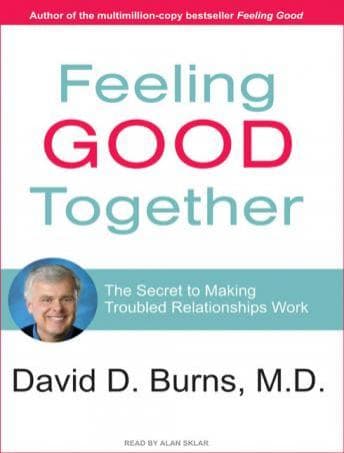

So here's the thing everyone says about David Burns: Feeling Good changed their life. The original CBT bible. Revolutionary. And then they pick up Feeling Good Together expecting the same dopamine hit of self-improvement clarity, and instead they get... a mirror pointed directly at their face. I was not prepared for that while stirring a pot of dal at 9 PM on a Tuesday.
Burns opens with something that genuinely made me set down my wooden spoon: the idea that the person you're in conflict with is not the problem. You are. Or more precisely - and this is where it gets psychologically interesting - your belief that the other person needs to change is the problem. The protagonist of every troubled relationship, Burns argues, exhibits classic externalization. We all think we're the reasonable one. We all think we're the good communicator. The research actually shows we're almost universally wrong about this.
The Part Where Burns Makes You Uncomfortable
What separates this from a hundred other relationship books is the Blame Cost-Benefit Analysis. Burns walks you through this exercise where you list all the advantages of blaming the other person - and he's honest, there ARE advantages, it feels righteous, it protects your ego - and then the costs. And he doesn't rush past this. He sits with it. He makes you sit with it. I found myself asking: why does Burns structure the entire first third of the book around dismantling your desire to be right, before ever teaching a single communication technique? Because he's a good clinician, that's why. He knows the tools won't work if you're still clinging to the belief that you're the victim.
The Five Secrets of Effective Communication framework is where the practical meat lives. Disarming technique. Thought and feeling empathy. Inquiry. "I feel" statements. Stroking. (My therapist would have thoughts about that terminology, but Burns means genuine affirmation of the other person.) What's clever here is that Burns uses extended dialogue examples - actual back-and-forth scripts between therapist and patient, or between couples - and he shows the wrong response first, then the revised response using his techniques. In audio format, this plays out almost like a radio drama. You hear the bad version and think "yeah, that sounds like something I would say," and then the corrected version and think "...oh. Oh no."
Alan Sklar Does the Boring Thing Well (And That Matters)
Let me be honest: Alan Sklar's narration is competent and clear, but it's not going to make anyone's heart race. He reads Burns's clinical examples with steady, professional delivery - no dramatic flair for the dialogue sections where a little vocal differentiation between the "patient" and "therapist" voices would've helped. The scripts are already doing a lot of heavy lifting in terms of illustrating Burns's points, and a narrator who leaned into the emotional dynamics of those exchanges could have elevated the whole experience. Sklar keeps it clean and intelligible, which for an 8.5-hour self-help audiobook is genuinely fine. You're not here for performance. You're here to learn something. But I did notice my attention drifting during the longer example dialogues because the vocal texture stayed pretty uniform.
At 8 hours and 30 minutes, the pacing is reasonable, but Burns does repeat his core framework multiple times with different relationship scenarios - romantic partners, parents, colleagues, friends. If you're someone who grasps a concept quickly and doesn't need four variations, you might find the middle section a bit circular. I bumped the speed to 1.25x around hour five and didn't lose anything.
What Psychologically Tracks (And What Doesn't Quite)
As someone who studies how people construct narratives about themselves and others, Burns's core insight is solid. The Cognitive Interpersonal Therapy framework is basically saying: the story you tell yourself about the relationship IS the relationship problem. That tracks with decades of attribution research. Where I got a little skeptical is Burns's claim that these techniques can resolve "virtually any kind of relationship conflict almost instantly." That's... a big claim. The research on interpersonal effectiveness training shows meaningful improvement, sure, but "almost instantly" does a lot of heavy lifting, and I think Burns oversells the speed of change in a way that could actually discourage people when their first attempt at disarming technique doesn't magically fix Thanksgiving dinner with their mother.
But here's what I kept coming back to, scraping the last of the dal from the pot at nearly midnight: Burns is fundamentally right that most of us are addicted to being the wronged party. We rehearse our grievances like monologues. We cast ourselves as the protagonist and the other person as the antagonist. This is a fascinating case study in how narrative psychology operates in everyday relationships, even if Burns doesn't use that terminology. He's essentially asking you to rewrite the story. That question of how we construct and defend our personal narratives obsessed me just as much when I was reading Answering the Question: What is Enlightenment? — different context entirely, but the same uncomfortable prod at the stories we tell ourselves about who we are and why we're right.
Who Needs This (And Who Will Hate It)
If you're currently in a conflict and you're 100% sure the other person is the problem? This book is specifically for you, and you will hate approximately the first three hours. If you've already done significant therapy work on communication patterns, the framework might feel familiar - Burns is drawing from established CBT and interpersonal therapy traditions, not reinventing the wheel. But as an accessible entry point to understanding your own role in relational dynamics? Pretty effective.
Skip it if you want validation. Listen if you want change.
My Diagnosis
Not a perfect audiobook - the narration is serviceable rather than inspired, and Burns occasionally promises more than cognitive science can deliver. But the core framework is psychologically sound, the exercises are genuinely useful if you actually do them (narrator won't pause for you, so have a journal ready), and the uncomfortable mirror Burns holds up in the first act is worth the price of admission alone. Just maybe don't listen while cooking. You'll burn something while having an existential crisis about your communication style. Ask me how I know.