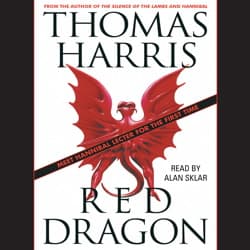

I've been a nurse long enough to know what real monsters look like. They don't have fangs or red eyes. They're quiet. Methodical. They blend in. So when people ask me why I read psychological thrillers after spending twelve hours watching actual trauma unfold, I tell them: Thomas Harris gets it. He understands that the scariest thing isn't the violence itself - it's the mind behind it.
Red Dragon has been on my list forever. I finally got to it during a brutal stretch of night shifts last month, and honestly? The timing was almost too perfect. There's something about driving home at 6 AM, sun just coming up, listening to Alan Sklar describe crime scenes while you're still processing the chaos of your own shift. It hits different.
The Forensics Actually Hold Up
Here's what surprised me - Harris did his homework. The forensic pathology, the behavioral analysis, the way Will Graham's mind works through evidence? It's not Hollywood garbage. As someone who's actually worked codes and seen what violence does to human bodies, I appreciate when a writer respects the reality. The clinical precision in how Harris describes the aftermath of these killings - it's not gratuitous. It's accurate. And that makes it so much worse.
Will Graham's psychological deterioration throughout the book is also remarkably well-done. The way his empathy becomes a liability, how he literally has to think like a killer to catch one - that's not something most people understand. But anyone who works in healthcare, especially trauma care, gets it. You have to compartmentalize. You have to step into dark spaces mentally to do your job. And sometimes you don't come back the same.
The Hannibal Lecter scenes are brief but devastating. This isn't Silence of the Lambs where he's the main attraction. Here, he's a scalpel - precise, surgical, used sparingly. And that makes him more terrifying.
Sklar's Lecter Is Perfect. Everyone Else Blurs Together.
Okay, so here's where I have to be honest. Alan Sklar nails Hannibal Lecter. That cultured, predatory intelligence comes through perfectly. When Lecter speaks, you stop whatever you're doing and listen. The dramatic modulation works beautifully for those scenes.
But - and this is a big but - everyone else sounds pretty much the same. Will Graham, Crawford, Dolarhyde, the various FBI agents... they all blend together. I found myself rewinding more than once going "wait, who just said that?" The women are even worse. Reba McClane deserves better than what she got here. Her character is so important to the story, and the narration just... doesn't differentiate her enough.
Frustrating, because when Sklar is good, he's really good. The suspense builds perfectly. The pacing never drags (and at almost 12 hours, that's saying something). But the character differentiation issue kept pulling me out of the story.
Harris's Prose Carries It
Here's the thing - Thomas Harris's prose is so strong that even imperfect narration can't sink it. The writing is understated in the best way. He doesn't tell you how to feel. He just shows you what's happening and trusts you to be horrified on your own. Blue Cross has that same restraint - lets the horror speak for itself. That's hard to do, and most thriller writers can't pull it off.
The Francis Dolarhyde chapters are genuinely disturbing. Not because of graphic violence - though there's plenty of that - but because Harris makes you understand him. Green Rust tried something similar with its antagonist, though it didn't quite land with the same impact. You see how he became what he is. And that's the scariest part. Monsters aren't born. They're made. Slowly. Painfully. One wound at a time.
Carlos asked why I was so quiet after my last shift. I blamed exhaustion, but honestly? I was still processing Dolarhyde's grandmother. Some things stick with you.
Who's This For (And Who Should Skip)
If you want your thriller actually thrilling - procedural accuracy, psychological depth, slow-burn dread that builds chapter after chapter - this is the real deal. Perfect for night shift drives home. Skip it if you need distinct character voices in your audiobooks; the narration will frustrate you during dialogue-heavy scenes.
Clocking Out
This is the book that started it all. Before Silence of the Lambs, before the movies, before Hannibal became a cultural icon - there was Red Dragon. And it holds up. Sklar's Lecter is worth the price of admission, but you'll need to pay attention to track who's talking. Not a dealbreaker, but worth knowing going in.
Just maybe don't start it right before bed. Trust me on that one.