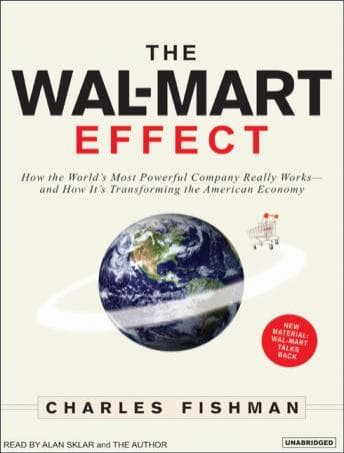

This is basically a horror book disguised as business journalism.
I'm not even kidding. I started this one on a Sunday night because I couldn't sleep after a deploy went sideways, and by 1AM I was lying in bed genuinely disturbed by a chapter about salmon. Salmon. Fishman spends an entire section tracing how Walmart's demand for cheap farmed salmon — vacuum-sealed, $4.84 per pound — basically warped the entire global salmon farming industry, from Chilean fjords to your grocery cart. The way he walks you through the economics of that single SKU is the kind of investigative work that makes you stare at your fridge differently.
The Distributed System That Ate America
Here's what Fishman gets right that most business books whiff on: he treats Walmart less like a company and more like a protocol. If you've ever worked with distributed systems, you'll recognize the pattern — Walmart is basically a coordination layer that imposes its own standards on every node in the network. Suppliers, truckers, small-town economies, international labor markets — they all get shaped by the same relentless optimization function: lowest price, always.
The Vlasic pickles story is the one that'll stick with me. Fishman describes how Walmart convinced Vlasic to sell a gallon jar of pickles for $2.97. A gallon. It sold insanely well — like 240,000 jars a week — but the margins were so thin it was actually cannibalizing Vlasic's own product line and hemorrhaging their profitability. And Vlasic couldn't say no, because pulling out of Walmart meant losing access to something like 30% of the entire grocery market. It's a vendor lock-in story, basically. AWS could never.
The book is structured as a series of these case studies — each chapter zooms into a different angle of the Walmart effect. The lawn mower factory that moved to China. The Snapper brand that deliberately refused to sell through Walmart to protect its premium positioning (one of the few companies that said no and survived). The small towns where the arrival of a Walmart Supercenter guts the local economy like a precision airstrike.
Alan Sklar Does the Heavy Lifting
Let me compare this to other business audiobooks I've endured at 1.75x: most of them have narrators who sound like they're reading a pitch deck at a corporate retreat. Sklar is different. He's got this deep, steady voice that makes data-heavy sections feel like someone's telling you a really good story over coffee instead of presenting quarterly results. No dramatic pauses where they don't belong. No fake enthusiasm. Just a clean, metered delivery that keeps the information flowing without putting you to sleep or making you rewind.
I bumped this to 1.5x (my default) and it sat perfectly in that zone. At 1.75x — my usual speed for business books that could've been blog posts — the data density was a bit much. This is actually a book with enough substance that it earns its 10.5 hours. Could it be tighter? Sure, maybe by an hour. But Fishman is building arguments with evidence, not padding chapters with anecdotes to justify a book deal.
Charles Fishman also narrates portions himself, which adds a nice layer of authenticity to the investigative sections. You can tell when he's reading his own material versus the chapters Sklar handles — Fishman's delivery is more conversational, a bit rougher around the edges, but it works because you're hearing the journalist who actually doorstepped former Walmart execs. The same quality — a narrator who sounds like they've actually lived inside the material — is what made Thinking, Fast and Slow work so well on audio too, though that one I had to dial back to 1.25x just to keep up with Kahneman's layering.
The 2006 Problem (And Why It Barely Matters)
Okay, the elephant in the room: this book is from 2006. Pre-Amazon-dominance. Pre-same-day delivery. Pre-Walmart's own e-commerce pivot. Some of the specific numbers are dated, and there's zero discussion of how Amazon has since given Walmart a taste of its own medicine.
But here's the thing — the mechanics Fishman describes haven't changed. The way a dominant platform reshapes supply chains, crushes supplier margins, and externalizes costs? That's not a Walmart-specific story anymore. Swap "Walmart" for "Amazon" or "Apple's App Store" and half the chapters read like they were written last week. The framework is evergreen even if the data points aren't.
Who Gets ROI From This
Perfect for: train, gym. Skip for: bedtime (the economic anxiety will keep you up — ask me how I know).
If you work in tech and think platform economics started with Silicon Valley, this is a reality check. If you've ever built a product that depends on a single distribution channel and wondered what happens when that channel squeezes you — Fishman already wrote your horror story, just with pickles and lawn mowers instead of APIs.
Skip if you need current data or are looking for a prescriptive "here's how to fix it" book. Fishman is a journalist, not a consultant. He shows you the machine. He doesn't hand you the wrench.
Commute-Worthiness: Cleared for 6AM Brain
I finished this in about 5 commutes, and it held my attention through every packed Caltrain car. The chapter structure is modular enough that you can zone out for a station stop and pick back up without losing the thread. The ROI on this audiobook is high — you'll come away understanding supply chain economics, monopsony power, and vendor dynamics better than most MBA grads, and you'll have strong opinions about pickle jars.
Kevin asked me why I was ranting about salmon farming at dinner. I told him to add it to the list.