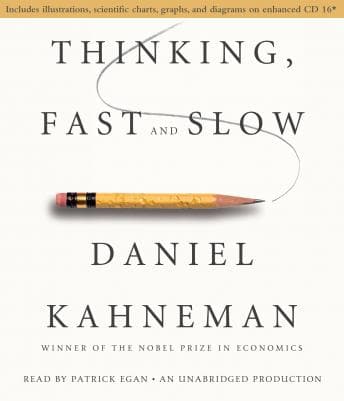

The Documentation for Your Brain You Didn't Know You Needed
It's 6:15 AM on the Baby Bullet to Mountain View. I'm three sips into a lukewarm coffee, staring at a guy debugging Python on his laptop, and I'm listening to Daniel Kahneman explain exactly why my brain is lying to me.
I picked this up because every VP of Engineering I know has it on their shelf (usually unopened, let's be real). I wanted to see if the hype was real or if it was just another "business thought leader" doorstop.
Spoiler: It's the real deal. But man, it is dense. Like reading documentation for a legacy system where the original developer was drunk.
System 1 vs. System 2 (Or: Why We Are All Buggy Software)
Here's the quick version of the whole 20-hour experience: Your brain has two threads.
System 1 is your cache. Fast, automatic, emotional, handles 98% of your inputs. It's what makes you swerve when a car brakes in front of you.
System 2 is the heavy compute. Slow, lazy, logical, drains your battery. This is what you use when you're actually trying to solve a distributed systems problem.
Kahneman spends 20 hours explaining that we think we're running on System 2 (logic), but we're almost always running on System 1 (vibes). And System 1 is full of race conditions and biases.
Listening to this was... humbling? Terrifying? I realized halfway through Chapter 4 that my decision to refactor that service last week was purely Sunk Cost Fallacy (System 1) masquerading as "technical debt reduction" (System 2).
The Audio Experience: Debugging the Format
Let's talk about Patrick Egan.
Narrating a 20-hour book about cognitive psychology without putting the listener into a coma is a feat. The material is academic—Nobel Prize stuff—but Egan reads it with this energetic, modulated tone that keeps you engaged. He doesn't sound like a professor lecturing you; he sounds like that one super-smart PM who's really excited about the Q3 roadmap.
I listened at my standard 1.75x, but I actually had to throttle down to 1.5x for the probability sections. (Yes, I slowed down. Don't tell Kevin.) Egan's pacing is excellent, but your brain needs a buffer to process the logic puzzles.
However. We need to talk about the UX bugs.
There are parts of this book clearly designed for eyeballs, not earballs. Kahneman loves a good visual illusion or a chart. The audiobook comes with a PDF, but let's be honest—I'm standing on a moving train. I'm not opening a PDF. There are moments where the narrator says, "Look at the figure below," and I'm just staring at the foggy window like, "Okay, I'll take your word for it."
Also, the "pop quizzes." The author asks a question to demonstrate a bias, pauses for you to think, and then—in the text—the answer is probably right there. In audio, if you don't pause immediately, Egan barrels right into the explanation. Can be jarring if you're trying to play along.
The Verdict
Is it commute-worthy? Absolutely.
The ROI on this book is massive. It changes how you argue, how you interview candidates, and how you debug your own bad decisions. Prince had a similar effect on me—totally recalibrated how I think about power dynamics in meetings. It's basically a patch for your cognitive operating system.
Just be warned: You might realize you're not as logical as you think you are. And if you're an engineer, that hurts.
Who should listen: Engineers, PMs, anyone who makes decisions under uncertainty and wants to understand why they keep getting it wrong. Who should skip: If you need something light for a beach vacation, this ain't it—save it for focused commute time.
(Pro tip: Don't listen to the section on "Loss Aversion" right after checking your stock portfolio. Just... don't.)









