
I teach Thoreau's Walden every spring to juniors who couldn't care less about a guy who lived in a cabin for two years. "Mr. Williams," they say, "he literally walked to town for dinner. That's not wilderness, that's camping with a safety net." And you know what? They're not wrong. But here's what kills me - these same kids who mock Thoreau's performative nature retreat haven't climbed a tree since elementary school. Haven't caught a frog. Haven't been bored outside long enough to discover anything about themselves.
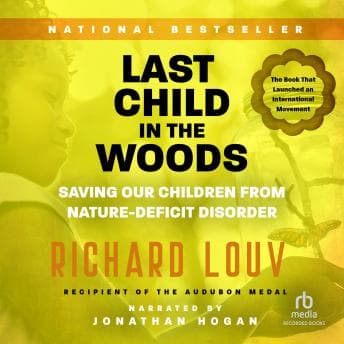
Richard Louv would have a field day with my students. Actually, he does. Twelve hours of it.
The Diagnosis Nobody Asked For (But Everyone Needed)
Louv coined "nature-deficit disorder" and I initially bristled at it. Another medicalized term for normal childhood, I thought. Another thing to add to the list of ways we're failing kids. But listening to this while grading sophomore essays at 11 PM - Denise already asleep, the apartment quiet except for Jonathan Hogan's steady voice - I found myself nodding along like I was at a particularly good faculty meeting. (This has literally never happened at an actual faculty meeting.)
The book isn't a guilt trip, though it easily could be. Louv builds his case methodically, drawing on research about attention, creativity, and what happens to developing brains when their primary landscape is screens and structured activities. He interviews parents, educators, urban planners. He talks to kids who've never seen the Milky Way because of light pollution. He talks to kids who think food comes from grocery stores, full stop. The disconnect between reality and perception that Louv describes here echoes the questions Byron Katie raises in I Need Your Love - Is That True? about the stories we tell ourselves versus what's actually true.
This reminds me of what Hemingway said about writing - the dignity of movement of an iceberg is due to only one-eighth of it being above water. Louv's visible argument is about children and nature. But underneath? He's really asking what kind of humans we're making when we remove wildness from childhood entirely.
Jonathan Hogan Does the Work
Hogan narrates like a thoughtful NPR correspondent - clear, engaged, never condescending. He doesn't try to make the research sections exciting through vocal gymnastics. He trusts the material. For a book this dense with studies and statistics, that restraint matters. I listened at 1.0x because the prose deserves to be savored, and because Louv's sentences have a rhythm that gets lost at higher speeds.
The narration shines brightest during the interview sections. Hogan finds subtle shifts for different voices without doing full character work - a slight change in cadence for a worried parent, a gentler register for the children's quotes. It's interpretation, not performance, and for nonfiction that's exactly right.
At twelve hours, this is a commitment. I won't pretend every chapter grabbed me equally. The policy sections - while important - occasionally felt like I was back in grad school reading urban planning theory. But Louv always returns to the human element, to specific kids and specific places, before I could fully zone out.
What Louv Is Really Saying
Here's where my English teacher brain kicks in. The surface argument is "kids need nature, here's the evidence, here's what we can do." But the deeper argument is about imagination itself. Louv suggests that unstructured time in natural spaces - where you have to make your own entertainment, where the landscape isn't designed for you - is where creativity and self-knowledge develop.
My students would hate this. I love it.
Because he's essentially making the case for boredom. For not knowing what's going to happen. For risk that isn't simulated. And as someone who watches teenagers curate their every moment for social media, who sees them anxious about unscheduled time - this landed hard.
Louv doesn't romanticize some pastoral past. He acknowledges the real dangers of the world, the reasons parents keep kids inside. But he argues we've overcorrected so dramatically that we've created new problems - obesity, depression, attention disorders - that may be worse than the risks we were avoiding.
Who Should Wander Into These Woods (And Who Should Skip)
Parents will find this essential, even if parts feel like preaching to the choir. Teachers - especially those of us watching attention spans shrink in real time - will find vocabulary for what we've been sensing. Urban planners, pediatricians, anyone who works with kids.
Skip it if you want quick fixes. Louv is building a philosophy, not handing out activity cards. If you're already convinced and just want practical tips, the final sections deliver some, but you'll wade through a lot of diagnosis first. And if you fundamentally believe screens and structured activities are fine and the kids are alright? This book will annoy you. Louv has a point of view. He's not pretending to be neutral.
Worth Pausing the Faculty Meeting For
I finished this on a Sunday morning walk along the lakefront with Denise. We didn't talk much - just watched the waves, noticed the birds, felt the wind. Exactly the kind of unstructured outdoor time Louv champions.
I thought about my students. About the ones who can't sit still, who seem unable to focus on anything longer than a TikTok. About whether Thoreau's cabin would feel like prison or paradise to them. About what we've traded for safety and convenience.
This is why we still read the classics - and why we need books like this to remind us what we're losing when we don't. Louv isn't Thoreau, but he's doing similar work: asking us to look at what we've accepted as normal and wonder if it has to be this way.
The prose won't win literary awards. The narration won't make you forget you're listening to nonfiction. But the argument? The argument might change how you think about childhood, nature, and what kids actually need to become fully human.
My mom will probably fall asleep during my podcast episode about this one too. But I'm making it anyway.