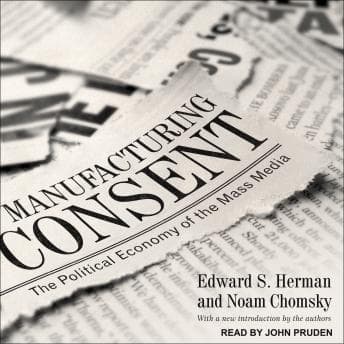

Everyone tells you this book will change how you see the news. They're right, but nobody warns you that the audiobook version will also test your relationship with consciousness itself.
I was making chana masala - the proper way, with whole spices I toasted myself, because my mother would haunt me while still alive if I used pre-ground - when I started this. Fifteen and a half hours. That's the commitment here. And I want to be honest: I almost didn't make it.
The Propaganda Model Is Basically a Diagnostic Framework for Media Pathology
Here's what grabbed me as someone who spends her life studying why people believe what they believe. Herman and Chomsky aren't doing media criticism the way most people understand it. They're doing something closer to what I do with fictional characters - building a structural model of behavior. Their five filters (ownership, advertising, sourcing, flak, anti-communism) function like a personality assessment for institutional media. You don't need conspiracy. You don't need shadowy figures pulling strings. You just need structural incentives, and the system produces consent on its own.
Psychologically, this tracks. Hard. The research actually shows that people don't need to be explicitly told what to think - they just need their information environment shaped in particular ways. Herman and Chomsky understood this decades before behavioral economics made it trendy. The "worthy" versus "unworthy" victims framework - where coverage of a murdered Polish priest gets wall-to-wall treatment while comparable (or worse) atrocities by U.S.-backed regimes in Guatemala or El Salvador barely register - that's not just media analysis. That's a case study in selective empathy, and it's the kind of thing that makes me want to assign this in my psych seminars. Thomas Sowell does something structurally similar — building a case through historical patterns rather than ideology — in Black Rednecks and White Liberals, and it provoked the same "wait, let me sit with this discomfort" reaction in me.
I found myself asking: why does this framework still feel so applicable forty years later? Because the filters are structural, not ideological. Ownership has concentrated further. Advertising has mutated into platform algorithms. But the bones of the model? Disturbingly intact.
John Pruden and the Fifteen-Hour Endurance Question
Okay. The narration. This is where I have to be fair and also honest, and those two things are fighting each other.
Pruden's delivery is clear. Genuinely clear. Academic texts are hard to narrate because the sentence structures are brutal - subordinate clauses nested inside subordinate clauses, statistical references, long quotations from government documents. He doesn't stumble. He doesn't lose the thread. That matters.
But - and this is a significant but - the monotone quality is real. By hour six, during the Indochina coverage analysis (which is meticulously argued but also incredibly dense), I was losing focus even while actively cooking. I had to switch to my morning jog the next day just to stay alert, and even then I found myself rewinding sections because my brain had drifted to thinking about whether I needed to buy cumin. The narration doesn't modulate to signal when you're hitting a key argument versus supporting evidence. Everything comes at the same emotional register. For a book that's fundamentally about how information presentation shapes perception... the irony is painful.
I'd recommend 1.25x speed. Not because he's slow, exactly, but because a slightly faster pace creates a sense of momentum that the natural delivery lacks. It helped me substantially in the back half.
Who This Is Really For (And Who Should Run)
This is not a casual listen. I cannot stress this enough. If you want an introduction to Chomsky's media criticism, read a summary first, then decide if you want the full academic treatment. This book is structured like a dissertation - thesis, methodology, case studies with exhaustive evidence. It's the kind of thing where they don't just tell you media coverage was biased; they count column inches and compare body counts across parallel situations.
If you're an academic, a journalist, a political science student, or someone who genuinely wants to understand the structural mechanics of media bias rather than just yell about it on social media - this is essential. The analytical framework alone is worth the time.
If you're looking for something to keep you company on a road trip? Absolutely not. You'll zone out somewhere around the Salvadoran election coverage and suddenly it's three hours later and you're in Delaware.
My Therapist Would Have Thoughts About This Book
Here's what stays with me. The most psychologically interesting thing about Manufacturing Consent isn't the propaganda model itself - it's how resistant people are to accepting it. We have this deep need to believe that information systems are fundamentally honest, that the truth will out. Herman and Chomsky basically say: no. The system isn't designed for truth. It's designed for consent. And your brain will fight that conclusion even as the evidence piles up, because accepting it means accepting that your entire informational environment is shaped by forces you can't see. That's not a comfortable realization to jog with at 6 AM through Cambridge. My therapist would definitely have thoughts about why I chose to do that to myself.
Worth the listen if you can handle the delivery. Just don't pretend it's going to be easy.