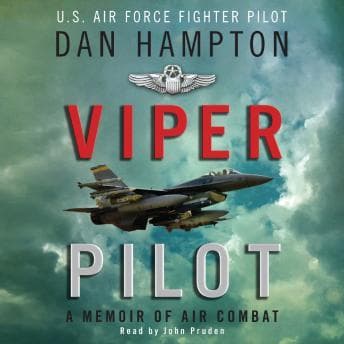

I listened to this during a red-eye from LAX to JFK last month. Couldn't sleep, had a strategy deck due in the morning, and instead spent four hours with Dan Hampton flying Wild Weasel missions over Iraq at 500 knots while surface-to-air missiles tried to kill him. Productive? No. Worth it? Absolutely.
Bottom line: This is the real thing. Hampton flew 151 combat missions in the F-16 across three conflicts, and he writes about it the way my parents talked about running their dry cleaning business - no mythology, no PR polish, just the actual texture of what it takes to do something extremely hard under extreme pressure. Most military memoirs give you the highlight reel. Hampton gives you the cockpit. The closest thing I've read to that same ground-level honesty in a completely different theater is Constellation of Vital Phenomena, which puts you inside the Chechen wars with the same refusal to mythologize what survival actually costs.
What It Feels Like to Have a SAM Lock Onto You
Here's what separates this book from every other 'I was a fighter pilot' memoir I've encountered: Hampton actually explains the electronic warfare piece. Wild Weasels - the F-16 crews tasked with hunting and destroying enemy radar and missile systems - are essentially flying bait. You light yourself up, wait for the enemy radar to lock onto you, then try to kill it before it kills you. Hampton walks through the sensor readings, the threat assessments, the split-second decision trees in a way that's technically specific without becoming a manual. I'm not an aviation guy. I'm a consultant who reads spreadsheets for fun. And I understood every bit of it.
The cockpit narratives in the Iraq War sections hit differently than anything I expected. Hampton describes acquiring a radar lock, watching the threat indicators, and choosing his attack angle with the same matter-of-fact precision my dad used to describe pressing shirts - except my dad wasn't getting shot at. This is what my parents did instinctively. Now it has a TED talk. Except Hampton skips the TED talk and just shows you the work.
His humor is dry and lands without warning. There's a particular quality to how he describes bureaucratic Air Force nonsense - the paperwork, the politics, the generals who've never been in combat making decisions about people who have - that reads like someone who's genuinely baffled that this is how institutions work. I've seen this fail at three different companies. Hampton's version just has more missiles.
John Pruden Is Doing Real Work Here
I'll be honest: I went in skeptical about the narration. Military memoirs often get narrators who sound like they're reading the news - technically fine, emotionally inert. Pruden is not that. His baritone sits at exactly the right register for Hampton's voice - confident without being performative, steady when the material gets intense. The combat sequences don't get louder or more dramatic in some theatrical way. They get tighter. More controlled. Which is exactly right for a pilot who's trained his panic response into something functional.
The military terminology is clean. No mispronunciations, no hesitations on call signs or aircraft designations. That matters more than it sounds - nothing breaks immersion faster than a narrator stumbling over 'HARM missile' or 'SEAD mission.' Pruden never stumbles. At my usual 2.0x, the pacing held up through the technical sections, which is the real test. Some narrators fall apart at speed when the material gets dense. This one doesn't.
Who This Is Actually For
If you read Tom Clancy for the hardware and skipped the character development, this is your book. If you've ever wanted to understand what air combat actually involves beyond the movie version, this is your book. If you're in business and want a case study in decision-making under genuine life-or-death time pressure - Hampton's framework for threat assessment maps surprisingly well onto crisis management, and I say that without irony.
If you need emotional arcs and personal transformation narratives, look elsewhere. Hampton isn't that guy. He's the guy who flew the mission, landed the plane, filed the debrief, and went back out the next day. The book reflects that. It's not cold - there are real moments of loss and reflection - but it doesn't wallow.
The key takeaway is worth the listen. The other 6 hours? Also worth the listen, actually. This is one of the rare military memoirs where the runtime earns itself. At 9 hours and 54 minutes, I finished it in two sittings. Jenny asked what I was listening to. I told her. She went back to her book. We both made the right call.





![Steve Jobs [unabridged audiobook] audiobook cover](/_next/image?url=https%3A%2F%2Fcovers.audiobooks.com%2Fimages%2Fcovers%2Ffull%2F9788499923406.jpg&w=1920&q=75)