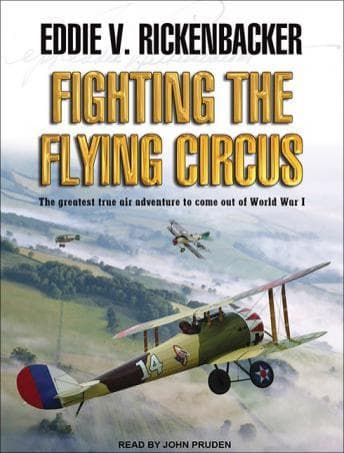

Look, I'll be honest—when I downloaded a WWI flying ace memoir, I wasn't expecting to feel things. I figured it'd be interesting background noise while I worked on a client's rebrand. History lesson, maybe some cool dogfight descriptions, done.
I was so wrong.
This Man Was Insufferably Cocky (And I Kind of Loved It)
Eddie Rickenbacker has the energy of that guy at the party who tells you he's the best at everything—except he actually is. The man was America's top WWI ace, Medal of Honor recipient, later ran Eastern Air Lines, and writes about it all with this casual confidence that should be annoying but somehow isn't. John Pruden's narration absolutely nails this. He captures Rickenbacker's competitiveness without making him sound like a complete jerk, and there's this undertone of "I know I'm green, but watch me anyway" that kept me hooked.
The 94th "Hat-in-the-Ring" Squadron stories hit different than I expected. These weren't faceless heroes—they were young men, barely trained, figuring out aerial combat in real time. That raw, unpolished courage reminded me of the voices in First World War Centenary Prose Collection Vol. I—different perspectives, same brutal learning curve. Rickenbacker writes about his inexperience with surprising honesty. One moment he's describing a kill with almost clinical precision, the next he's admitting he had no idea what he was doing up there. That vulnerability? Didn't expect it. Didn't expect to care this much about pilots who died a century ago.
Pruden's Golden Voice Carries the Long Haul
Ten and a half hours is a commitment, and I won't lie—the middle sections drag a bit. There's only so many mission descriptions before they start blending together. Some listeners apparently bailed around this point, and I get it. But here's the thing: John Pruden has one of those voices that makes you want to keep listening even when the content slows down. It's warm without being syrupy, authoritative without being stiff. He earned that Earphones Award.
What really impressed me was how Pruden handled Rickenbacker's tonal shifts. The book swings between technical flight details, moments of genuine terror, and this almost boyish excitement about aviation. Pruden doesn't flatten any of it. When Rickenbacker describes watching a friend's plane go down, there's weight in the delivery. When he's bragging about outmaneuvering a German pilot, you can hear the grin.
The Boring Parts Are Actually the Point
Okay, so here's where I'm going to defend the slow sections that made some listeners quit. War isn't all dramatic dogfights. A lot of it is waiting, mechanical failures, weather delays, the grinding monotony between moments of terror. Rickenbacker includes all of that, and while it's not thrilling, it feels true. These men spent more time on the ground than in the air. The repetition isn't lazy writing—it's reality.
Did I zone out during a few missions? Yes. Did Frida knock my phone off the desk during a particularly detailed description of engine trouble? Also yes. But when the action picked back up, I was grateful for the context. The quiet parts make the chaos hit harder.
Abuela Would Have Had Questions
I kept thinking about my grandmother while listening to this. She loved stories about brave men doing impossible things—her telenovela heroes just happened to be fictional. Rickenbacker was real, and his confidence would have made her laugh. "Mija, this man thinks he invented flying," she'd say. But she would have listened to every hour. She loved a good brag when it was earned.
There's something about hearing a firsthand account from someone who lived through history that hits different than reading about it in a textbook. Rickenbacker isn't just recounting events—he's reliving them. You can feel his pulse quicken during close calls. You can feel his grief when squadron mates don't come back. This is memory, not history. It's messier and more human.
Who Should Climb Into This Cockpit (And Who Should Stay Grounded)
If you want constant action, this isn't it. If you need emotional peaks every chapter, you'll be frustrated. But if you're the type who can appreciate a slow build, who finds beauty in historical detail, who wants to understand what early aviation actually felt like from someone who was there—this is your book. Skip it if you're looking for a quick, adrenaline-fueled listen; lean in if you want to sit with something that earns its weight.
Listen during focused time, not as background noise. The details matter, and Pruden's subtle vocal work rewards attention. I'd suggest 1.0x speed—there's no rush here, and speeding through would lose some of the atmospheric weight.
My Heart Flew With These Ghosts
I finished this audiobook at 2 AM, cats asleep on my keyboard, client deadline completely forgotten. I didn't ugly-cry—this isn't that kind of book. But I felt something deeper. Reverence, maybe. Gratitude that someone bothered to write it all down, that Pruden bothered to give it voice again.
Rickenbacker and his squadron are long gone, but for ten hours, they flew again. And I got to ride along.







![Steve Jobs [unabridged audiobook] audiobook cover](/_next/image?url=https%3A%2F%2Fcovers.audiobooks.com%2Fimages%2Fcovers%2Ffull%2F9788499923406.jpg&w=1920&q=75)