
This is what my parents did instinctively. Now it has a TED talk.
I'm not being glib. My mom and dad ran a dry cleaning business in Koreatown for 25 years, and they understood something that Clayton Christensen spent a decade researching at Harvard: customers don't walk in because they want "dry cleaning services." They walk in because they have a job interview tomorrow, or a funeral, or a date they're nervous about. The clothes are just the vehicle. The job is the thing.
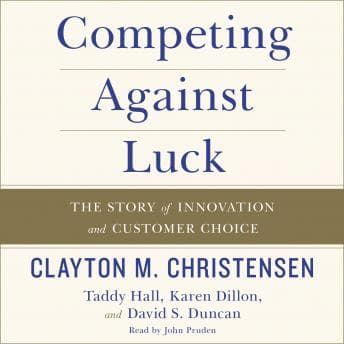
Competing Against Luck finally gives this intuition a framework. And unlike 80% of the business books clogging my Audible library, this one actually earns its 7+ hour runtime.
The Milkshake That Launched a Thousand Consultants
Christensen's famous milkshake study is here, and it's worth the price of admission alone. A fast-food chain wanted to sell more milkshakes. Traditional market research—demographics, preferences, stated needs—got them nowhere. Then Christensen's team asked a different question: What job are customers hiring the milkshake to do?
Turns out, morning commuters were "hiring" milkshakes to make a boring drive less boring. They needed something thick enough to last the whole commute, engaging enough to provide entertainment, and filling enough to stave off 10 AM hunger. They weren't competing against other milkshakes. They were competing against bananas, bagels, and boredom. Kitchen Confidential operates on the same principle—Bourdain understood that diners weren't hiring a restaurant for food, they were hiring it for transformation, for a story to tell.
I was on a red-eye back from a client meeting in Seattle when this section hit. Cramped in 14C, trying to make sense of why a Series B startup's product was failing despite hitting every customer survey checkbox. The milkshake framework clicked something into place. Their customers said they wanted features. What they actually needed was confidence that they weren't screwing up.
Where It Earns Its Keep
The book's strength is in the practical application chapters. Christensen and his co-authors (Karen Dillon, Taddy Hall, David Duncan—this is a team effort) don't just give you the theory. They show you how to find the job, how to validate it, how to organize around it. The Intuit and Amazon examples are solid. The Southern New Hampshire University case study is genuinely surprising—a nonprofit college that grew 34% annually by understanding that adult students weren't hiring a degree. They were hiring a path to a better version of themselves.
John Pruden's narration is clean and intelligent. No vocal fireworks, but that's not what you want here. He reads like a smart colleague walking you through a deck—clear pacing, good emphasis on the framework terminology without making it feel like a glossary recitation. I listened at 1.5x (generous for me) and nothing got lost.
The Padding Problem (Because There's Always Padding)
Look, I'll be honest. This could've been a 5-hour book. The middle sections repeat the core concept with different examples, which is useful for retention but frustrating if you've already internalized the framework. Chapters 7 through 9 feel like they're making sure you really got it. I got it. Skip to chapter 5 if you're already familiar with Christensen's earlier work. Thank me later.
Also—and this is a minor gripe—the book occasionally falls into the consulting trap of making simple things sound proprietary. "Jobs to Be Done" is a great framework. It's also, fundamentally, empathy plus rigor. My parents called it "knowing your customers." But I get it. You can't charge McKinsey rates for "knowing your customers."
(Jenny would say I'm being harsh. Jenny is right. But also, I'm not wrong.)
Who Should Hire This Book (And Who Shouldn't)
Product managers, founders, anyone in innovation roles—this is required listening. If you've ever sat in a meeting where someone said "but the customer said they wanted X" and you knew in your gut that X wasn't the real problem, this book gives you the vocabulary to push back.
Skip it if you're looking for quick tactics or growth hacks. This is strategic thinking, not a playbook. It requires actual reflection. And if you haven't read The Innovator's Dilemma and The Innovator's Solution, start there—this book assumes some familiarity with Christensen's worldview.
Net-Net
The core framework is worth the listen. The extra 2 hours of repetition? Not so much. But unlike most business books, Jobs to Be Done is genuinely predictive. I've used it with three clients since finishing this, and it's changed how we approach product-market fit conversations.
My parents never read business books. They were too busy working. But if I could translate this into Korean and make them listen, they'd nod and say, "We know. We always knew." That's the highest compliment I can give a business book—it codifies what the best operators already understand intuitively.
Worth the credit. Worth your time. Just maybe not at 1.0x.