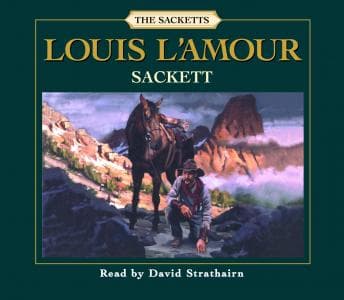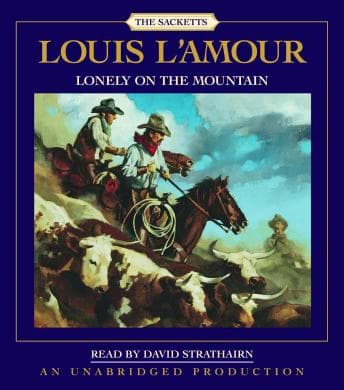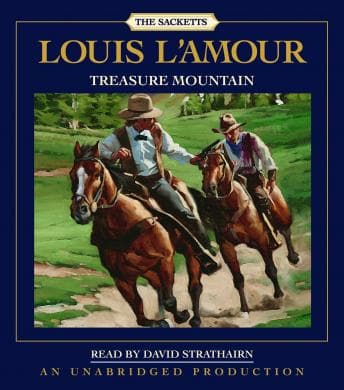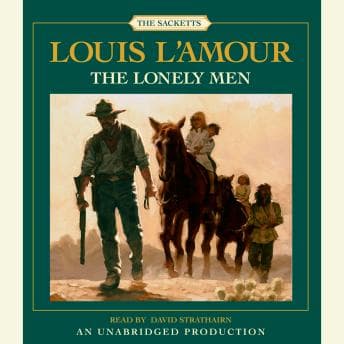

"The only things he can depend on are his wits and cold steel." That line kept rattling around my head while I was up late cleaning my Beretta at the kitchen table - Linda already asleep, Ranger sprawled out on the tile watching me with one eye open. Five hours and change of Tell Sackett crossing into Apache territory in the Sierra Madres, and I'll be honest: it scratched an itch I didn't know I had.
Let me cut to the chase. This is a tight, no-fat Western that moves like a patrol through hostile terrain. L'Amour doesn't waste your time, and at just over five hours, neither does the audiobook.
Tell Sackett Operates Like a Soldier Who's Been Burned Before
What I appreciate about Tell as a character - compared to some of the other Sacketts in this sprawling series - is his operational paranoia. The man doesn't just worry about the Apache threat in front of him. He's running a mental threat assessment on his own sister-in-law, wondering if she's setting him up to get killed so her husband's brother is out of the picture. That dual-threat dynamic kept me engaged in a way that a straight rescue mission wouldn't have. It's not just "go get the kid." It's "go get the kid while figuring out if the person who sent you wants you dead."
L'Amour clearly did his homework on Apache tactics and the terrain of the Sierra Madres. The way he describes the landscape - the way Tell reads ground sign, conserves water, thinks about sight lines - it felt right. I've seen this scenario play out in real life, albeit in different deserts. The fundamentals of moving through territory controlled by people who know it better than you? Those don't change much whether it's 1870s Sonora or 2004 Anbar Province. Tell's respect for the Apache as fighters, even as adversaries, is something L'Amour handles with more care than you might expect from a Western novel written decades ago. That same careful treatment of people caught between cultures and loyalties reminded me of what Arthur Koestler does in Darkness at Noon — a completely different world on the surface, but the same unflinching honesty about what it costs a man to hold his convictions when everything around him is trying to break them.
But here's where it gets interesting for the Sackett series veterans: this one sits in that sweet spot of the saga where L'Amour has already established the family bonds, so there's a shorthand. You don't need fifty pages of backstory. Tell shows up, the situation is bad, and he moves. If you haven't read earlier entries, you'll be fine - but you'll miss some of the weight behind why Tell would cross into Mexico on what might be a trap.
Strathairn Reads Like a Man Who's Actually Been Dusty
David Strathairn's narration is the right tool for this job. His voice has this dry, weathered quality that fits L'Amour's prose like a broken-in pair of boots. No theatrics, no overcooked dramatic pauses. Just a steady, confident delivery that lets the story do the work.
Now, I'll be straight with you - I don't have a lot to say about his character differentiation because the narration is pretty uniform in tone. He's not doing wildly different voices for every character. But for this kind of story? It works. Tell Sackett is the narrator of his own tale, and Strathairn keeps that first-person perspective feeling authentic rather than performed. The no-nonsense style matches L'Amour's writing so well that you forget someone is reading to you. You just... hear Tell talking.
Compare this to some of the other Sackett audiobook narrators, and Strathairn holds up as one of the better choices the series has gotten. He doesn't try to be bigger than the material. Smart move.
The Five-Hour Problem (That Isn't Really a Problem)
At 5 hours 21 minutes, this is essentially a long afternoon listen. I knocked most of it out on a round trip to a client site in San Antonio. And honestly, the length is both the book's strength and its limitation. L'Amour keeps the pace hot - you're moving, things are happening, there's genuine tension about who Tell can trust. But the ending comes fast. Almost too fast. You spend the whole book building toward this confrontation, and then it resolves with the kind of efficiency that feels... earned but abrupt. Like the author had somewhere to be.
That said, I'd rather have a lean story that respects my time than a bloated one that doesn't. L'Amour understood that a good Western operates like a good ambush: set it up, spring it, get out.
Who Saddles Up and Who Stays in Town
If you're already invested in the Sackett family saga, this is required reading. If you're new to L'Amour, it's a solid entry point - short commitment, good narrator, classic Western structure. If you need complex character psychology and literary ambiguity, look elsewhere. This is a man-on-a-mission story told by a master of the genre, read by a narrator who knows exactly what the material needs.
Worth your time? Here's the debrief: it's a quick, satisfying listen that won't change your life but will make your commute disappear. At 1.25x it flies by even faster, and Strathairn's delivery handles the speed bump just fine.
Ranger approved this one. He perked up during the Apache pursuit sequences - or maybe that was just the deer outside. Either way, mission accomplished.