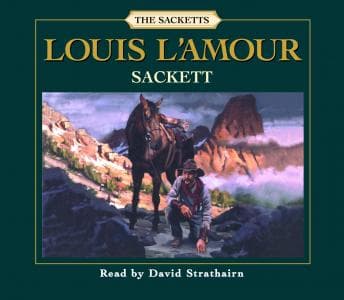

"The rare letters Tell Sackett received always had trouble inside."
That's how L'Amour opens this thing, and I had to pause mid-grading—red pen hovering over some sophomore's mangled thesis about symbolism in The Scarlet Letter—because that single sentence does more work than most novels manage in fifty pages. It tells you everything about Tell Sackett: a man whose family only reaches out when things go wrong, and a man who answers anyway.
The Iceberg Principle, Western Style
This reminds me of what Hemingway said about writing—that the dignity of movement of an iceberg is due to only one-eighth of it being above water. L'Amour's working that same principle here. Tell doesn't explain his loyalty to cousin Logan. He doesn't justify risking his life crossing Sioux territory with a cattle herd. He just saddles up and rides north while prairie fires and war parties try to stop him.
The prose is lean, declarative, almost aggressive in its efficiency. L'Amour writes like he's being charged by the word. No fat. No meandering internal monologues about the meaning of family or the nature of the frontier. Just forward motion and a man who keeps his word.
At under six hours, it's compact—almost too compact. The ending arrives faster than you expect, leaving some threads dangling like a rope cut mid-throw. I understand why some listeners felt shortchanged. But I'd argue that's part of the Western tradition. These men don't get tidy conclusions. They get survival, or they don't. L'Amour chose to end when the work was done.
Strathairn Trusts the Silences
David Strathairn has that voice. You know the one—weathered but not tired, authoritative but not theatrical. He sounds like a man who's spent actual time outdoors and knows when to shut up and let the landscape do the talking.
He relies on tone and pacing rather than theatrical accent work—the Sackett brothers emerge through subtle shifts in cadence, a slightly harder edge here, a more measured delivery there. It's understated, which is exactly right for L'Amour. I've heard narrators try to juice up Western novels with dramatic flourishes, and it always feels wrong. Like putting a spoiler on a pickup truck. Strathairn just drives.
The man understands that pause is punctuation. He trusts L'Amour's spare sentences to carry their own weight.
The Shadow Following Tell
The mysterious enemy tracking Tell across the Dakotas and into the Canadian Rockies adds genuine tension to what could otherwise be a straightforward cattle drive narrative. L'Amour understood that the West wasn't just about nature trying to kill you—it was about the men who'd follow you into that wilderness to finish the job.
There's something almost mythic about the premise. A man receives word that his cousin will starve or hang, and he simply goes. No committee meeting. No risk assessment. Just the bone-deep certainty that Sacketts don't abandon Sacketts. My students would call this "outdated masculinity" or "problematic individualism," and maybe they'd have a point. But there's also something clarifying about characters who operate by a code, even when that code might get them killed.
Who Should Saddle Up (And Who Should Ride On)
If you loved Sackett or The Lonely Men, this is their spiritual successor—same family loyalty, same Western landscapes, same men who solve problems with rifles and stubbornness. Strathairn brings that same unhurried authority to Mojave Crossing, another Sackett entry where the narrator's restraint does as much heavy lifting as the prose itself. If you're new to L'Amour, this actually works as an entry point. The family connections are referenced but not required reading.
But if you need elaborate character development or subverted expectations, ride on past. L'Amour wrote for readers who wanted the Western myth delivered straight, no irony, no deconstruction. The good guys are good. The bad guys are bad. The land is beautiful and will kill you without malice.
L'Amour pulls off that same unironic moral clarity in Comstock Lode, which I'd put on the same shelf as this one for anyone who wants their genre fiction delivered without apology.My students would hate this. I love it.
The short runtime makes it perfect for covering ground—I'd recommend it for driving, actually. There's something right about listening to a cattle drive while you're moving through your own landscape. I finished this one walking the lakefront with Denise, the Chicago skyline behind us feeling very far from the Dakotas but the story working anyway.
Class Dismissed
This is why we still read the classics—even the genre classics that English departments pretend don't count. L'Amour understood that loyalty, landscape, and forward motion are enough. Strathairn delivers it clean. The ending's rushed, sure, but so is life on the frontier.
Principal Martinez, if you're reading this, I was definitely paying attention during that budget presentation last Tuesday. (I wasn't. I was riding through the Canadian Rockies with Tell Sackett, and I regret nothing.)