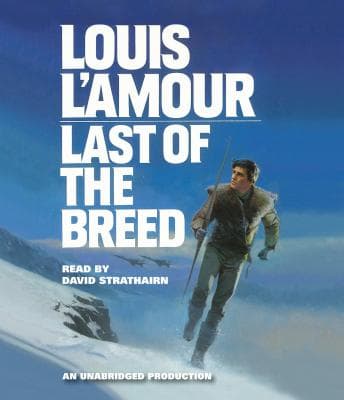

Louis L'Amour writing a Cold War thriller about a Sioux Air Force pilot escaping across Siberia is not the sentence I expected to type today. And yet here we are.
I've been teaching American literature for two decades, and I thought I knew L'Amour's territory - dusty trails, cattle drives, the mythic West. But Last of the Breed threw me completely. This is L'Amour doing something I didn't know he had in him: taking the survival skills and ancestral knowledge of his typical frontier heroes and transplanting them into Soviet Russia. It shouldn't work. It absolutely works.
When Ancestry Becomes Survival Strategy
Major Joe Mack is a fascinating protagonist precisely because L'Amour refuses to make him simple. He's a modern Air Force officer with advanced degrees and experimental aircraft clearance. He's also Sioux and Cheyenne, raised by a grandfather who taught him to track, hunt, and survive in ways that predate European contact. When his plane goes down in Russia and he escapes a Soviet prison, these aren't competing identities - they're complementary ones.
What struck me most, grading papers at midnight with this playing through my headphones, was how L'Amour treats Joe Mack's heritage. It's not mystical or romanticized. It's practical. Joe survives because his grandfather taught him to read animal tracks, to move silently, to understand weather patterns. The Soviets can't comprehend how he keeps slipping away because they're thinking like modern military strategists while he's thinking like a man whose ancestors crossed the Bering Strait in the opposite direction thousands of years ago.
There's something almost poetic about that - a Native American man returning to Asia by reversing the ancient migration route. L'Amour doesn't hit you over the head with it, but it's there if you're paying attention.
David Strathairn Understands the Assignment
Here's the thing about narrating L'Amour: you can't phone it in. The man wrote with such specificity about landscape and survival techniques that a narrator who rushes through the descriptions kills the whole experience. Strathairn - and this is an Oscar-nominated actor, mind you - treats every passage about tracking or weather or terrain with the same gravity he'd give Shakespeare.
His Joe Mack is quiet and capable without being wooden. His Russian characters actually sound Russian without descending into parody. There's a strategic patience to Joe that reminded me of Art of War - that same understanding that survival isn't about force, it's about reading your opponent and the terrain. (My students would appreciate that I noticed this. They mock my attempts at accents when I read aloud in class. They're not wrong to mock me.)
But what really got me was Alekhin, the Yakut tracker hunting Joe. Strathairn voices him with genuine respect - this isn't a cartoon villain. He's a man of the land just like Joe, operating from a different tradition but with the same fundamental understanding of the wilderness. The cat-and-mouse between them becomes something like a conversation between two old ways of knowing the world.
The Slow Burn That Pays Off
I'll be honest - this is not a fast-paced thriller in the modern sense. L'Amour spends chapters on Joe building shelter, finding food, reading the Siberian landscape. If you need constant action, you'll struggle. But if you've ever loved Hatchet or My Side of the Mountain, if you find survival details genuinely compelling rather than tedious, this is your book. That same primal tension between man and wilderness runs through Call of the Wild, though London's setting trades Siberia for the Yukon.
I listened during my lakefront walks with Denise, and the pacing matched perfectly. There's something meditative about L'Amour's prose when you're moving through space yourself. The descriptions of Siberian taiga started blending with the Chicago shoreline in my head. (Don't tell Denise I wasn't fully present for our conversations. She already suspects.)
At 13 hours, it's a commitment. But Strathairn's pacing never drags. He understands that L'Amour's detailed passages aren't filler - they're the point. This is a book about patience, about ancestral knowledge, about the long game. The narration honors that.
Who This Is (and Isn't) For
If you've dismissed L'Amour as "just westerns," this might change your mind. It's still recognizably his voice - the spare prose, the competent heroes, the respect for practical knowledge - but the Cold War setting gives it unexpected weight. Skip it if you need romance, if survival details bore you, or if you can't handle a protagonist who's quietly capable rather than flashy. This isn't wish fulfillment action. It's something stranger and more interesting.
My students would probably hate the pacing. I loved it. That's usually how I know I've found something worth recommending.