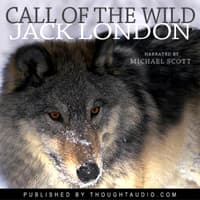

I was grading a stack of sophomore essays on symbolism in Lord of the Flies - yes, the irony is not lost on me - when I decided I needed something to keep me from losing my mind. Three and a half hours later, the essays were graded, my red pen was dry, and I'd just experienced Jack London's Call of the Wild in a way I hadn't since I first read it in college. Different beast entirely in audio form. Pun intended.
What London Actually Wrote
Here's the thing about teaching classics for two decades: you forget how good they actually are. You remember the themes, the discussion questions, the essay prompts. You forget the prose. London's sentences in this book are muscular and lean - no fat, no showing off. Just clean, brutal efficiency. The man wrote about the Yukon like he was carving it into stone.
Buck's transformation from pampered California dog to something ancient and wild - it's not subtle. London isn't interested in subtle. He's interested in truth, and the truth he's after is that civilization is a thin veneer over something much older and much more honest. My students would probably call this "problematic" or whatever, but London's not romanticizing violence. He's documenting a kind of spiritual awakening. Buck doesn't become cruel. He becomes real.
At three hours and change, this is the perfect length. London knew when to get out. No bloat, no unnecessary subplots, no padding. The man said what he came to say and left. (Modern authors, take notes.)
Michael Scott's Approach
Now, I couldn't find much about this particular Michael Scott online - and no, not that Michael Scott, though I'd pay good money to hear Steve Carell attempt this - but based on this performance, he understands something crucial about narrating London: you don't need to oversell it.
The pacing is deliberate. Measured. He lets the prose breathe, which matters when you're dealing with sentences like "He was mastered by the sheer surging of life, the tidal wave of being." That's not a line you rush through. Scott gives it weight without tipping into melodrama. The restraint is actually refreshing.
Character differentiation is... adequate. Look, this isn't a dialogue-heavy book. Buck doesn't speak. The humans are mostly functional - they exist to teach Buck lessons about the world, not to have rich inner lives. Scott handles the various mushers and miners fine, though I'll admit I occasionally lost track of who was talking during the middle sections. Not a dealbreaker, but worth noting.
What he nails is Buck's emotional journey. The moments of violence have impact. The quieter moments - Buck dreaming of the primitive man by the fire, the growing pull of the wild - feel genuinely contemplative. There's one passage near the end, when Buck finally answers the call, where Scott's voice drops to almost a whisper. Gave me actual chills. At 11 PM. Surrounded by essays about Piggy's glasses.
The Listening Experience
This is a commute book. A walk-by-the-lakefront book. It's short enough to finish in a weekend of errands, and the chapters are episodic enough that you can pause without losing the thread. I wouldn't recommend it for bedtime unless you want to dream about being chased by wolves. (Denise asked why I was twitching in my sleep. I blamed the caffeine.)
The production is clean - no weird audio artifacts, no jarring music cues. Just voice and story. Old school. I appreciate that.
One thing: if you're expecting the 2020 Harrison Ford movie, this ain't that. The book is darker, more ambiguous about what Buck's transformation means. The movie softened it. London didn't soften anything.
Who Should Listen (And Who Should Skip)
If you read this in middle school and remember it as "that dog book," you're ready to hear what it actually is. It's a meditation on nature versus nurture, on the violence inherent in survival, on what we lose when we become civilized and what we might gain if we could go back. Heavy stuff wrapped in adventure-story clothing.
If you're a purist about narrator accents or need distinct character voices, this might frustrate you in spots. Scott's approach is more "literary reading" than "full performance." I happen to think that's the right call for London, but your mileage may vary.
Scott takes a similar approach in Alice In Wonderland, letting the prose carry the weight instead of trying to do all the heavy lifting with character voices.
Pair this with White Fang if you want the inverse story - wild to civilized instead of civilized to wild. London basically wrote two sides of the same philosophical argument. The man was nothing if not thorough.
Life of P.T. Barnum has that same philosophical thoroughness—Scott narrates that one too, and he brings the same measured restraint to a completely different kind of American story.
Final Thoughts
Three and a half hours. That's it. That's all it takes to experience one of the great American novels in a format that actually enhances the prose. Michael Scott's narration won't win awards for vocal pyrotechnics, but it serves the material honestly. Sometimes that's exactly what a classic needs - a narrator who trusts the words.
I'm adding this to my "books my students should listen to instead of watching the movie" list. Right after The Great Gatsby and right before 1984. They won't listen to me. They never do. But at least I tried.
Buck would understand.