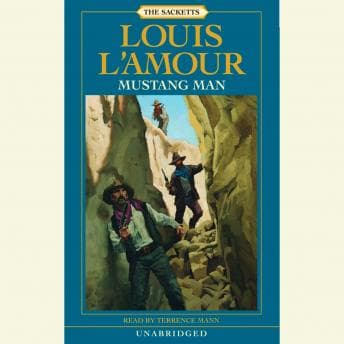

Look, I have a bone to pick with Louis L'Amour. The man wrote something like ninety novels, most of them under two hundred pages, and every single one of them makes me feel like I've been sitting in a saddle for a week even though I've never been on a horse in my life. Mustang Man clocks in at four hours and forty-three minutes, and I burned through it during a Saturday afternoon where Denise dragged me to her sister's house and I "volunteered" to sit on the back porch while they planned some baby shower. Perfect cover. Perfect book for it, too — lean, sunbaked, and blunt as a fist.
Here's my complaint, though: Nolan Sackett is not a complicated man. He tells you this himself, repeatedly. He's hungry. He's broke. He's good with a gun and bad with polite company. And L'Amour writes him with that stripped-down, declarative prose that makes Hemingway look ornamental. Sentences like rocks rolling downhill. Subject, verb, done. After twenty years of teaching students to develop their ideas, to expand, to give me paragraphs that breathe — listening to L'Amour feels like watching someone win a knife fight with three moves. Efficient. Almost annoying in how effective it is.
The Loneliest Sackett Gets a Voice
Terrence Mann narrates this one, and if you've been listening to the Sackett series with David Strathairn handling most of the duties, Mann is a different animal. Where Strathairn gives you that quiet, lived-in authority, Mann leans into Nolan's rougher edges. There's a gravel to his reading that fits a character who's more outlaw-adjacent than the other Sacketts. When Nolan meets Penelope Hume in that cantina at Borregos Plaza — the scene that kicks the whole plot into motion — Mann plays the moment with this wary curiosity, like a man who knows a pretty woman with a treasure map is always more trouble than the treasure.
Now, the pauses. I need to talk about the pauses. Mann takes these long, deliberate beats between sentences that some listeners have found maddening, and I understand why. In a book this short, every pause costs you something. But here's the thing — and my students would roll their eyes at me for saying this — the narrator understands that pause is punctuation. L'Amour's prose is already sparse. Those silences fill in what the words don't say. When Nolan is watching the Karnes family — Sylvie, Ralph, and Andrew, that nest of vipers circling Penelope's inheritance — Mann lets moments hang in the air the way a man with a rifle lets a target settle in his sights. It's deliberate. It's not for everyone. But at 1.0x speed, which is the only speed I'll listen to anything (I know, I know, I'm ancient), those pauses worked for me. If you're a 1.5x listener, I could see them driving you up a wall.
Gold, Bones, and the Canyon Nobody Visits
The plot itself is classic L'Amour — a treasure hunt wrapped in a survival story wrapped in a body count. Penelope's grandfather hid gold in a canyon that Indian legend says is cursed, filled with the bones of men, no birds, no insects. Nothing living. L'Amour doesn't belabor the supernatural angle — this isn't a horror novel — but he lets that emptiness sit there like a warning. And when Nolan and Penelope finally approach it, Mann's voice drops into something almost reverent. It's one of those moments where narration becomes interpretation, and it reminded me why I believe audio performance is its own art form.
The Karnes family, though — they're the real engine here. Sylvie is the dangerous one, smarter and more ruthless than her brothers, and L'Amour writes her with this cold pragmatism that feels genuinely threatening in a genre that doesn't always know what to do with its women. Mann voices her with a controlled precision that contrasts sharply with his rougher Nolan. Ralph and Andrew are blunter instruments, but L'Amour never makes them cartoons. Their entitlement to Penelope's gold is so total, so unquestioned, that it becomes its own kind of violence before anyone draws a weapon.
This is why we still read the classics — because L'Amour, for all his simplicity, understood something about greed as a family inheritance that plenty of "literary" writers never get right.
Who Rides Along and Who Stays in Town
If you love the Sackett series, this is a strong entry. Nolan is rougher company than Tell or Tyrel, and the book doesn't try to redeem him into respectability. If you loved Hondo or Last of the Breed, this is their leaner, meaner cousin. My students would hate this — too short, too old, too much silence. I love it.
But if you need complex character arcs or prose that shows off, L'Amour isn't your man. He never was. And if those pauses in Mann's narration sound like a dealbreaker, maybe try a sample first. My podcast episode on After You got into this same territory — how a narrator's pacing can either make you trust the silence or fight it the whole way through.
Four hours and forty-three minutes. I finished it before the baby shower planning was done. Denise found me on the porch with my eyes closed and thought I was napping. I was listening to a man walk into a canyon full of bones. Better afternoon than I deserved.