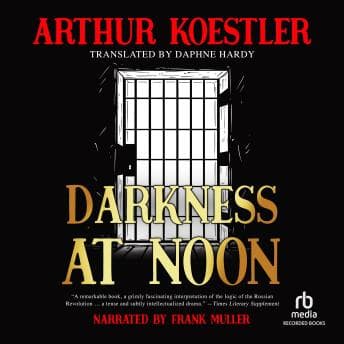

Eleven PM. Papers half-graded, red pen running dry, and Rubashov is pacing his cell in my earbuds while I'm pacing my kitchen waiting for the coffee to brew. There's something almost obscene about listening to a man being psychologically dismantled while you're deciding whether to give a sophomore a C+ or B- on their Gatsby essay. But that's the thing about Koestler—he makes you feel complicit. You're not just observing the machinery of totalitarianism. You're sitting in the interrogation room.
I'll admit I came to this one late. Twenty years teaching literature and I'd somehow only ever taught 1984 and Brave New World when discussing dystopian fiction. I should probably add Dune to that rotation too—different flavor of dystopia, but equally concerned with how power corrupts idealism. My students would hate this admission. (They'd also hate this book. Too slow. Not enough plot. No romance. Perfect.)
The Rhythm of a Man Arguing Himself Into Oblivion
What struck me first wasn't the politics—it was the structure. Koestler doesn't give you a thriller about escape or resistance. He gives you something far more disturbing: a man who knows he's going to die and spends eight hours trying to decide if he deserves it. Rubashov was the revolution. He believed in the cause so completely that he sacrificed others for it—friends, lovers, idealists who trusted him. Now the revolution has decided he's expendable too.
The prose deserves to be savored. Koestler writes in these tight, philosophical spirals that mirror Rubashov's own circular thinking. You'll catch yourself nodding along to an argument about historical necessity, and then you realize you've just agreed with the logic that justifies show trials. That's the trap. That's the whole point.
Frank Muller—and I don't say this lightly—understood this book in his bones. His pacing matches Koestler's rhythm exactly. When Rubashov is reasoning through his past betrayals, Muller's voice takes on this measured, almost academic quality. When the interrogations intensify, he doesn't shout or melodramatize. He just... tightens. The intensity comes through in the precision of each word, not volume. It's the difference between a teacher raising their voice and a teacher getting very, very quiet. (My students know which one means real trouble.)
What Hemingway Would Have Cut—And Why Koestler Kept It
Hemingway said the dignity of movement of an iceberg is due to only one-eighth of it being above water. Koestler inverts that. He puts the whole iceberg on the page. Every philosophical argument. Every memory. Every justification and counter-justification.
Some listeners will find this exhausting. I found it essential.
The book demands your full attention. I tried listening while grading once and had to rewind twenty minutes because I'd absorbed nothing. This isn't background listening. This is the kind of audiobook that requires you to sit with it, argue with it, occasionally pause it to stare at the ceiling and wonder what you would have done in Rubashov's position.
Muller's narration helps here. He doesn't rush the philosophical passages or try to inject false drama. When Rubashov compares himself to Moses—led to the Promised Land but refused entry—there's this weight in Muller's delivery. Not grief exactly. Something closer to exhausted recognition. The man has spent his life believing in a future he'll never see, and now even that future has been revealed as a lie.
The Classroom Question Nobody Wants to Answer
I keep thinking about how I'd teach this. What discussion questions I'd write. And I keep coming back to one: At what point does believing in a cause become complicity in its crimes?
Koestler doesn't let you off the hook with easy answers. Rubashov isn't a monster. He's a true believer who followed the logic of his beliefs to their terrible conclusions. The Party taught him that the individual means nothing compared to history's march forward. So when the Party decides he means nothing—well, isn't that just consistency?
My students would want a villain. Someone to blame. Koestler refuses to provide one. The system is the villain, but the system is made of people who all believe they're doing what's necessary. That's the darkness at noon—not the absence of light, but the inability to see clearly even when the sun is directly overhead.
Class Dismissed (But You'll Keep Thinking About This One)
If you loved 1984, this is its spiritual successor—or really, its predecessor and inspiration. Orwell reviewed this book glowingly when it came out, and you can see its fingerprints all over his later work. Dune does something similar with its examination of messianic movements—showing us not just the oppression but the true believers who enable it. But where Orwell gives you the boot stamping on a human face forever, Koestler gives you the face trying to understand why the boot is necessary.
Skip this if you need plot momentum or narrative satisfaction in the traditional sense. This is a book about ideas wearing the costume of a novel. If you need things to happen, you'll be frustrated. But if you want to understand how intelligent people can convince themselves that atrocity is progress? If you want to hear what it sounds like when a man talks himself into accepting his own execution? If you want eight hours that will haunt your grading sessions for weeks afterward?
This is why we still read the classics. Not because they're old. Because they're still asking questions we haven't answered.