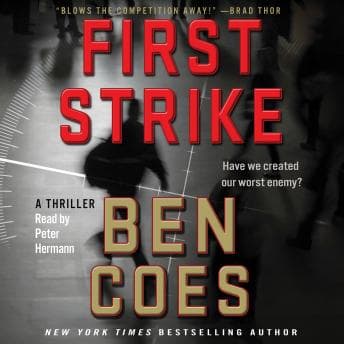

Look, I have a complicated relationship with military thrillers. The genre tends to treat psychology like a vending machine—insert trauma, receive motivation. But Ben Coes does something interesting with Dewey Andreas that kept me listening through my entire week of morning jogs.
Dewey owes his life to Kohl Meir. That's it. That's the whole engine driving this plot. And honestly? It works. Because debt—real, bone-deep obligation to someone who saved you—is one of the most psychologically authentic motivators in fiction. It's not revenge (overused), it's not patriotism (often hollow), it's personal. The research actually shows that humans will take extraordinary risks for people they feel indebted to. Coes gets this.
When Loyalty Becomes a Suicide Mission
Here's where my psychology brain started really engaging. Dewey has to rescue Meir from an Iranian prison AND find a nuclear bomb—without official backing from Israel or America. The protagonist exhibits classic self-sacrificial behavior patterns, but what makes it compelling is that Coes never pretends this is rational. Dewey knows the odds. He does it anyway.
The antagonist, Abu Paria, is where things get interesting. Head of VEVAK, described as "brutal and brilliant"—and for once, the narrative actually earns both adjectives. He's not a cartoon villain. He's competent. He notices Dewey's moves. Deception Point has a similarly competent antagonist who actually thinks several moves ahead—it's refreshing when villains earn their threat level. This creates genuine tension because you're watching two skilled operators try to outthink each other. (My therapist would have thoughts about my investment in this cat-and-mouse dynamic, but that's a separate session.)
The plot threads across multiple countries simultaneously—Brooklyn, Iran, Israel, probably a few others I'm forgetting. Paris Apartment: A Novel juggles multiple timelines in a single location, which is honestly easier to track than multiple locations in one timeline. Some listeners found this confusing. I'll be honest: there were moments on my jog where I had to rewind because I'd zoned out during a transition. The complexity is real. But I'd argue it's also realistic. International operations ARE messy. They don't happen in neat sequential order.
Peter Hermann's Gruff Authority
Peter Hermann narrates with this gruff, hard-boiled delivery that fits the material perfectly. He creates distinct personalities for the principal characters—and in a book with an international cast spanning American, Israeli, and Iranian characters, that's not nothing. His range of accents and dialects kept me oriented even when the plot jumped continents.
The Newark Star-Ledger called his voice versatility one of the strongest recommendations for the audiobook, and they're right. When you're dealing with this many characters, you need a narrator who can make you instantly know who's speaking. Hermann does that.
The weakness? The unrelenting grimness. Hermann's delivery is so consistently dark that it can actually lessen the impact of Dewey's accomplishments. When everything sounds dire, the moments of triumph don't pop the way they should. It's like listening to someone tell a joke in the same tone they'd use to announce a death. Psychologically, we need contrast to feel stakes. The narration doesn't always give us that. For eleven and a half hours of runtime, a little tonal variation would help. But if you're into the genre, you'll probably adjust.
Who's This Actually For?
If you're a fan of political and international espionage stories, a commute listener who needs something to make traffic disappear, or someone who appreciates realistic operational detail—you'll probably love this. Skip it if you're sensitive to grim tones, dislike complex multi-threaded plots, or prefer your thrillers with some romance or levity mixed in. There's violence. There's torture. There's the kind of political intrigue that requires you to actually pay attention. (I was cooking biryani during one chapter and had to restart it because I missed crucial plot points. Don't be me.)
Coes's background—White House work under two presidents, Kennedy School fellowship—shows in the authenticity of the political and military details. This isn't someone guessing how these operations work. The realism is a feature, not a bug.
Case Closed
The pacing takes a bit to get moving. Some listeners felt it was slow at the start, and I can see that. But once it locks in, it's genuinely addictive. The production is clean, no audio issues, and Hermann's delivery is professional throughout.
Would I listen again? Probably not—once you know how the nuclear threat resolves, some tension evaporates. But would I recommend it to the right person? Absolutely. Just know what you're getting into.