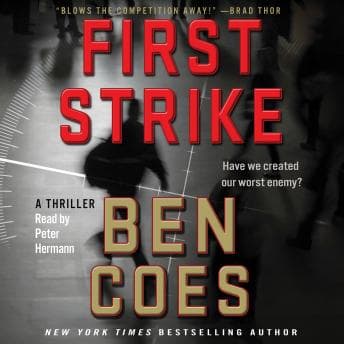

Look, I know what you're thinking. Jordan, you're a horror person. What are you doing reviewing a military thriller about a rogue CIA operative stopping a July 4th terrorist plot?
Fair question. But here's the thing—good thrillers and good horror operate on the same fuel: dread. The slow realization that something terrible is coming and you can't look away. Ben Coes gets this. And Peter Hermann? He commits.
The Grief That Actually Works
Dewey Andreas is a mess when this book opens. His fiancé was murdered, he's blown his last two operations, and his superiors have essentially benched him. This could've been eye-roll territory—the tortured hero trope is exhausted at this point. But Coes doesn't let Dewey wallow performatively. The grief is there in the margins, in the reckless decisions, in the way he goes rogue not because he's a maverick but because sitting still feels like dying.
Hermann captures this perfectly. There's a weariness in his delivery during the early chapters that shifts into something sharper, more focused, as Dewey finds his purpose again. It's subtle work. The kind of character arc that could've been heavy-handed but instead feels earned.
(Shirley was deeply unimpressed by the entire listening experience, for the record. She left the room twice. But she does that when I listen to anything that isn't ambient cat music, so.)
When the Snatch-and-Grab Goes Sideways
The plot kicks into gear when two teams—one going after a Russian hacker called Cloud, the other after his ballerina girlfriend—get ambushed and wiped out. Only Dewey's unauthorized intervention saves the ballerina, and what she reveals sends the whole thing spiraling into conspiracy territory.
I won't spoil it, but the scope of the plot is genuinely audacious. Like, "this is either going to be brilliant or completely ridiculous" audacious. Coes walks that line pretty well. The three-day countdown structure keeps everything tight, and the stakes feel real even when they're massive.
Hermann's pacing here is key. The action sequences are genuinely pulse-pounding—he speeds up just enough to create urgency without losing clarity. But he also knows when to pull back. The quieter moments with the ballerina, the strategic planning sessions—he gives them room to breathe. That balance is harder than it sounds.
The Voice Behind the Bullets
Peter Hermann is doing heavy lifting throughout these fourteen hours. His Dewey is exactly right—gruff, competent, damaged but not broken. The American accent is clean and neutral, which works for the setting. But where he really shines is character differentiation.
The Russian characters feel distinct. The CIA brass each have their own rhythms. The ballerina—who could've been a cipher—gets enough vocal personality that you actually care whether she survives. Some reviewers have noted that Hermann can get a bit monotonous during longer exposition sections, and yeah, there are a few stretches in the middle where I zoned out slightly. But those moments are rare, and he always snaps back when the action demands it.
The production quality is solid. Clean audio, well-balanced. There are apparently some sound effects and music integrated in, which—look, I'm usually skeptical of that stuff. It can feel gimmicky. But here it's unobtrusive enough that I barely noticed, which is probably the best compliment I can give.
Fourteen Hours That Don't Feel Padded
At fourteen hours, this isn't a quick listen. But it doesn't drag. The conspiracy unfolds at a good clip, the action set pieces are spread well throughout, and the emotional beats land when they need to. If you're into Vince Flynn's Mitch Rapp series or Mark Greaney's Gray Man books, this is absolutely your lane. I'd also throw Last Trial into that mix—different flavor, same commitment to tight plotting.
Is it horror? No. But that creeping sense of "oh no, this is bigger than anyone realizes" that drives the middle act? That's dread, baby. That's my genre bleeding into yours.
I listened to most of this during a late-night shelving shift at the library. Probably not the ideal context—I kept startling at noises and then feeling ridiculous about it. But the book held my attention through six hours of alphabetizing returns, which is more than I can say for most thrillers.
Who's This For (And Who Should Skip)
If you want a competent, well-paced military thriller with a narrator who actually understands the assignment, this delivers. Mitch Rapp fans, Gray Man devotees—you're home. Skip it if you need your protagonists emotionally stable or if conspiracy plots make you impatient. This one goes big.
Probably not a re-listen for me—it's a one-and-done plot-driven experience. But my podcast listeners who've been asking for thriller recommendations outside my usual wheelhouse? This is your entry point. Just maybe don't listen at 2 AM in a dark library. Learn from my mistakes.