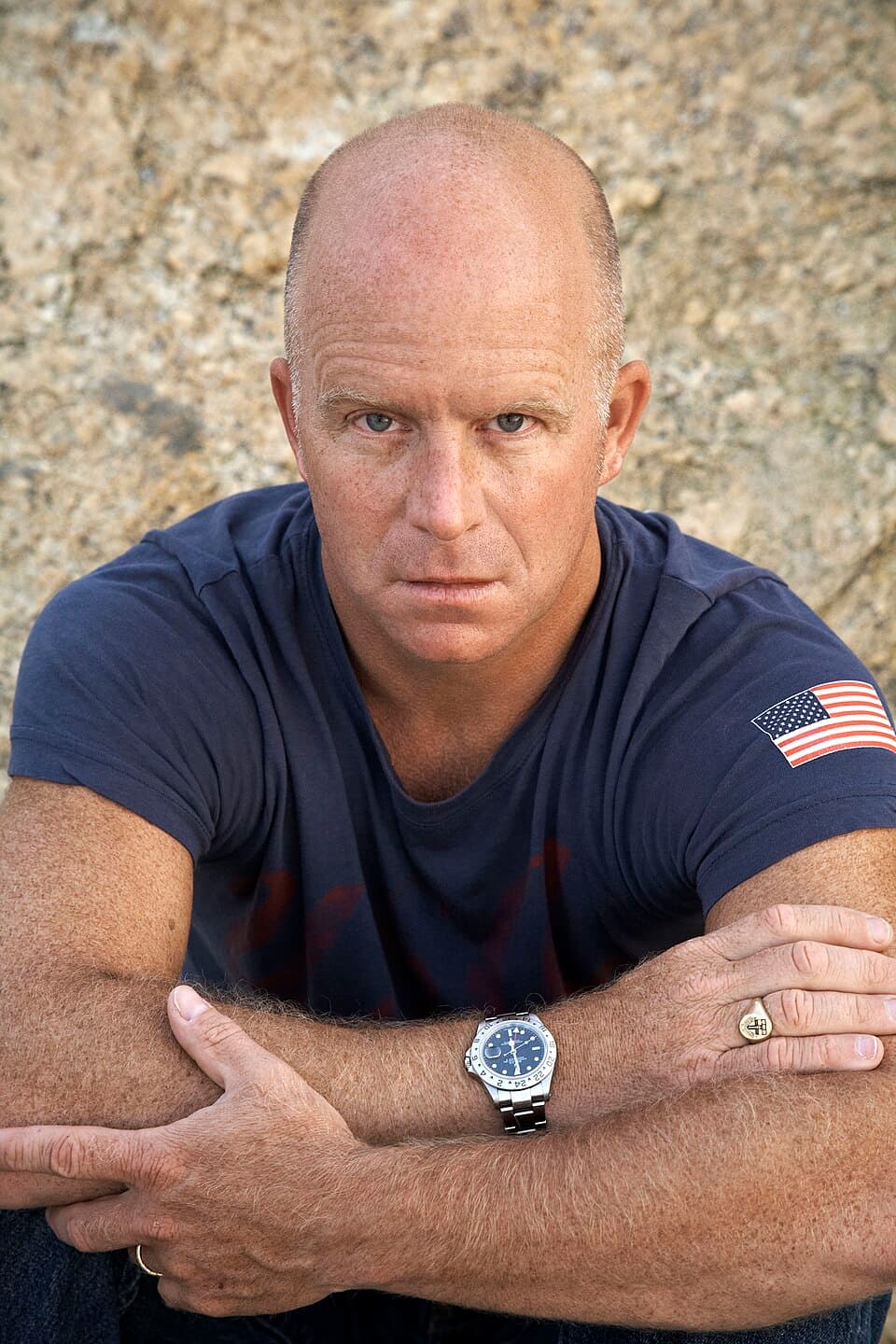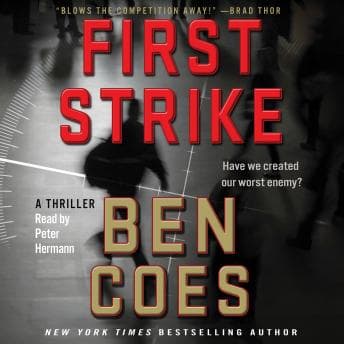

Ben Coes writes thrillers the way my mother makes dal — fast, aggressive, no apologies for the heat.
I finished First Strike while making chicken tikka masala at midnight, which felt oddly appropriate. A book about arms deals gone wrong, ISIS weaponized by American hubris, and a lone operative sent to clean up Washington's mess — all while I'm standing over a cutting board dicing onions and thinking about how every institution in this plot is failing exactly the way institutions fail in real life. Coes worked in the White House under two presidents, and you can feel that insider cynicism bleeding through the pages. This isn't a writer guessing at bureaucratic incompetence. He knows.
So let's talk about Dewey Andreas.
The Psychology of a Human Weapon
Dewey is a fascinating case study in what happens when you strip a protagonist down to pure operational competence and call it a personality. He's not brooding in interesting ways. He's not haunted by a dead wife in ways that inform his moral choices (well, not in ways that matter here). He's essentially a delivery system for violence with just enough human wiring to care about college kids being held hostage. The protagonist exhibits classic action-hero compartmentalization — emotions exist only when the plot needs them to, then they're neatly filed away so he can shoot someone through a wall.
Psychologically, this doesn't fully track for me. A man with Dewey's trauma history would have cracks. Real ones. Not the decorative kind Coes occasionally gestures at. But here's the thing — I found myself not caring, because the plot moves at such a ruthless clip that you don't have time to notice the characterization is thin. It's a magic trick. Coes distracts you with stakes so enormous (hundreds of hostages, public executions, an arms shipment that could destabilize the Middle East) that you forget to ask whether Dewey is actually a person.
Is that a compliment? I'm still deciding.
Tristan Nazir and the Villain Problem
What makes this book work better than it probably should is Tristan Nazir. I found myself asking: why does Nazir really turn? Coes gives us the mechanics — a covert Pentagon program that was supposed to install a friendly power broker, a man who takes America's weapons and builds his own empire instead — but the motivation underneath is more interesting than the book fully explores. Nazir isn't just greedy. He's someone who understood American power better than America did, and used it. That's not a cartoon villain. That's a mirror.
The Columbia University hostage scenario is where Coes really earns his keep. The calculus is genuinely terrible: release weapons that will kill thousands, or watch students die one by one on camera. There's no clean answer, and to his credit, Coes doesn't pretend there is. He just sends Dewey in and lets the math sort itself out. My therapist would have thoughts about a character whose solution to moral dilemmas is always "violence, but precise."
Peter Hermann Behind the Mic
Peter Hermann's narration is... look, it's complicated. His voice is deep, deliberate, and has this muscular quality that fits the testosterone-heavy material like a glove. When he's doing Dewey's internal processing — that flat, tactical thinking — it works beautifully. The slower, methodical pacing mirrors the way an operative would actually assess a situation. Measured. Controlled.
But here's where it gets tricky. That same methodical delivery can flatten scenes that need more emotional range. There's apparently a James Bond reference in a serious scene that some listeners found unintentionally hilarious because of the way Hermann delivers it, and I get that. The narration doesn't differentiate much between characters — you're not getting distinct vocal profiles for your CIA director versus your Syrian operative. It's essentially one voice modulated slightly. For a 14-hour listen, that asks a lot of your attention.
I didn't find him annoying, exactly. But I can see why listeners who came from five previous books with a different narrator would feel the whiplash. Continuity matters in a series. You build an association between a voice and a character, and breaking that is like recasting James Bond mid-film. (There's that Bond reference again.)
Who Gets the Most Out of This
If you want psychological complexity — if you need your characters to behave like real, messy humans with contradictory motivations — this isn't your book. Skip it. If you want a propulsive, well-researched thriller that understands geopolitical chess and delivers action sequences with brutal efficiency, First Strike does exactly what it promises. It's comfort food for the thriller-addicted brain. The research actually shows that readers of genre fiction often prioritize competence fantasies over character depth — and Coes knows his audience. Blood Lines scratches a similar itch — that same genre contract where you hand over your psychological expectations at the door and just let the plot carry you.
Series newcomers: you can probably start here without being lost, but you'll miss context on Dewey's history. Series veterans: brace for the narrator switch.
My Case Notes
Three stars and change. Coes understands structural tension the way a demolition expert understands load-bearing walls — he knows exactly which one to hit. The villain is smarter than the book gives him room to be. The narration is solid but monochromatic. And Dewey Andreas remains, after six books apparently, the most competent man alive who I still couldn't pick out of a psychological lineup.
I ate my tikka masala. It was better than the characterization but worse than the plot.