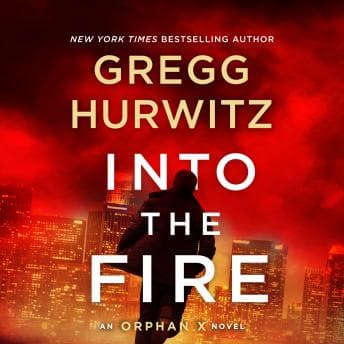

Okay, I need to talk about something that's been bothering me for twelve hours. Gregg Hurwitz wrote Evan Smoak as a man who has systematically eliminated every emotional attachment in his life - no permanent relationships, a penthouse designed for maximum tactical advantage, vodka distilled to mathematical perfection - and then keeps putting him in situations where he has to care about people. The protagonist exhibits classic avoidant attachment with a rescue compulsion layered on top, and honestly? My therapist would have thoughts about this character. Many thoughts. Billable thoughts.
I was making chicken tikka masala at like 10 PM on a Tuesday - one of those nights where the recipe becomes a meditation because your brain won't stop running - and Into the Fire had me standing over the stove with a wooden spoon frozen in mid-stir because Max Merriweather's situation kept escalating in ways that felt genuinely unpredictable. A cousin murdered, a mysterious key, and every person Max reaches out to becomes a target. This is a fascinating case study in how Hurwitz constructs paranoia: he doesn't just tell you the world is closing in, he removes exits one by one until you feel the claustrophobia yourself.
The Nowhere Man's Attachment Problem
What makes Evan Smoak compelling is the contradiction Hurwitz refuses to resolve. Here's a guy who lives by a numbered set of commandments - literally a personal code etched into his operating system - and yet the entire premise of being "The Nowhere Man" requires him to form temporary bonds with desperate strangers. I found myself asking: why does Evan really keep answering these calls? It's not altruism. It's not guilt, exactly. It's closer to what psychologists call "repetition compulsion" - he's replaying his own rescue from the Program, except now he's the rescuer. Chamber actually digs into a similar psychological loop - a character whose entire identity is built around a compulsion they can't name, let alone escape. He can't stop saving people because saving people is the only way he knows how to process being saved himself.
Hurwitz gets this. The author understands human nature well enough to let Evan be cold and caring simultaneously without it feeling like a writing cheat. Max Merriweather works as a client precisely because he's so ordinary - not a trained operative, not someone with useful skills, just a regular guy drowning. The power differential between Evan and Max creates this dynamic where you're watching competence meet vulnerability, and it's surprisingly emotional for a book with this much tactical weaponry.
Scott Brick: The Polarizing Constant
So here's where I have to be honest. Scott Brick narrates the Orphan X series like a man delivering a eulogy at a funeral where the deceased was also a spy. Every. Single. Line. Gets the same gravitas. A scene where Evan is calculating sniper angles? Intense. A scene where Evan is making breakfast? Also intense. A scene where someone explains what a key opens? Still intense.
And look - there's something to be said for his delivery. Brick conveys tension and urgency with genuine conviction. When the story actually calls for anxiety and paranoia, he's right there with you, and you feel it in your chest. But the problem is that when everything sounds urgent, nothing sounds urgent. It's like emotional inflation. By hour six, my nervous system couldn't distinguish between "someone is trying to kill Max" and "Max is having a conversation about parking." I bumped the speed to 1.25x and honestly? It helped. Gave the narration a forward momentum that counteracted the one-note intensity.
Brick isn't bad. He's committed. He's consistent across the series. But if you're someone who needs vocal range to differentiate between action sequences and quiet character moments, you're going to notice the gap. Psychologically, this doesn't track for me - the pacing of a story needs dynamic variation to let your brain process what just happened before the next thing hits.
Who's Going to Love This (And Who Should Run)
If you've been following the Orphan X series, this is a no-brainer. Hurwitz has built a character who deepens with each book, and the procedural elements - the gadgets, the tactical planning, the escalating threat structure - are tight. If you like Jack Reacher but wish he went to therapy (he won't, but Evan at least has self-awareness about his damage), this is your lane.
Skip it if unrealistic emotional stoicism bothers you without payoff, though I'd argue Hurwitz earns it here. The stoicism-as-survival-mechanism thing is something Full Bloom also plays with, though it lands differently when the armor cracking happens in a quieter, more internal story. And if Scott Brick's narration style drives you up the wall, maybe grab the print version. No shame in that.
Diagnosis: Functional But Worth Monitoring
The research actually shows that stories about hyper-competent loners tap into a very specific fantasy - not about being violent, but about being sufficient. Evan Smoak never needs to ask for help, never second-guesses, never spirals at 2 AM wondering if he said the wrong thing in a meeting. That's the real escapism here. And Hurwitz is smart enough to slowly crack that armor across the series, which is what keeps me coming back. Into the Fire is a solid entry - not the strongest psychological material in the series, but a well-oiled machine of escalating stakes that kept me stirring chicken tikka masala well past midnight.