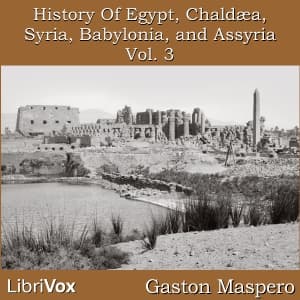

Most people hear "ancient Chaldean civilization" and their eyes glaze over. I get it. But I've always had a thing for understanding how empires rise and fall - spent enough time watching it happen in real time in Mesopotamia, which is literally where this book is set. So when I saw Maspero's Volume 3 sitting in my queue, covering ancient Chaldea, her gods, temples, and civilization, I figured it was time to dig in. Ranger and I were up late, couldn't sleep after a long day of client briefings, and I thought dense 19th-century Egyptology might be just the thing.
Let me cut to the chase: this is a significant scholarly work hampered by a narration that nearly sinks it.
Maspero Knew His Stuff Before "Knowing Stuff" Was Cool
Here's what you need to understand about Gaston Maspero - this guy was translating hieroglyphics largely self-taught, got put in charge of French archaeological missions in Egypt in 1880, and literally helped crack open the cache of royal mummies at Deir el-Bahri. He gave a 17-year-old Howard Carter his first job. Carter. The guy who found Tutankhamun. So when Maspero writes about Chaldean temple construction, religious practices, and the development of early urban civilization, he's not pulling from Wikipedia. He was there - well, as close to "there" as a late-1800s Frenchman could get.
Volume 3 focuses specifically on ancient Chaldea, and the material itself is genuinely fascinating if you've got the patience for it. Maspero's descriptions of Chaldean religious architecture, the pantheon of gods, and how temple life intersected with political power - that's the good stuff. This was originally published in French and translated in 1903-1904, so the prose has that formal, Victorian-academic cadence. Dense paragraphs. Long subordinate clauses. The kind of writing where you need to be locked in or you'll lose the thread entirely.
And that's where the problem starts.
When the Narrator Becomes the Enemy
Sibella Denton reads this at a pace that feels like she's trying to catch a flight. Other listeners have reported slowing her down to 0.7 or 0.8 speed just to process what's being said. Think about that for a second - I listen to most books at 1.25x. I had to slow this one down to 1.0x and still found myself rewinding. For material this dense, with unfamiliar Chaldean names, obscure geographic references, and 120-year-old academic prose, you need a narrator who gives you room to breathe. Denton doesn't.
But it's not just the speed. The delivery is flat. Monotone in a way that makes already dry material feel like reading a government procurement manual. No variation in emphasis, no sense that certain passages are more dramatic or significant than others. When Maspero describes the discovery of ancient temple complexes or the brutal politics of Chaldean city-states, those moments deserve some energy. Instead, every sentence gets the same treatment. One listener mentioned they spent more time listening for the click of a computer mouse in the recording than actually absorbing content. I didn't catch that specific issue, but I understand the frustration - when narration is this disengaging, your brain starts hunting for anything else to latch onto.
At 7 hours and 39 minutes, this isn't a massive commitment by audiobook standards. But it feels longer than it should because you're fighting the delivery the entire way.
The Real Question: Is the Source Material Worth the Struggle?
Honestly? For a specific audience, yes. Maspero's work is foundational. If you're interested in ancient Near Eastern civilizations - and I mean genuinely interested, not "watched a History Channel documentary once" interested - this is primary source scholarship from one of the discipline's pioneers. His observations about how Chaldean religious practices influenced later Babylonian and Assyrian cultures are the kind of connections that still inform academic discussion today. Machiavelli pulled off something similar in Prince - writing about power and statecraft so precisely that centuries later the observations still hold, even when the delivery feels like a slog through another era's assumptions.
I've walked through Mesopotamian ruins. I've driven past tells in Iraq that haven't been excavated. There's something quietly powerful about hearing a 19th-century scholar describe the same landscape with such precision and passion, even filtered through stiff Victorian translation. Maspero cared deeply about getting this right.
But - and this is a big but - this is Volume 3 of twelve. If you haven't tackled the first two, you'll be dropped into the middle of a massive historical narrative without context. And if Denton's pacing bothered people in Volume 1 (it did), nothing's changed here.
Who Should Saddle Up and Who Should Stand Down
If you're a history junkie with specific interest in ancient Mesopotamian civilizations, and you can handle academic prose from the early 1900s, slow Denton down to 0.8x and commit. Have a notepad handy. This is focus listening, not background noise.
If you want accessible, engaging history narration - the kind where the narrator's energy carries you through unfamiliar territory - this isn't it. Look for more modern treatments of the subject with narrators who understand pacing for audio.
Mission Assessment
Worth your time? Here's the debrief: the intelligence is solid but the delivery system needs work. Maspero's scholarship is the real deal. Denton's narration is the weak link in the chain. I finished it, Ranger slept through most of it (not a good sign), and I came away respecting the material while wishing someone else had read it. A frustrating listen that rewards patience - but only if you've got patience to spare.







![Steve Jobs [unabridged audiobook] audiobook cover](/_next/image?url=https%3A%2F%2Fcovers.audiobooks.com%2Fimages%2Fcovers%2Ffull%2F9788499923406.jpg&w=1920&q=75)