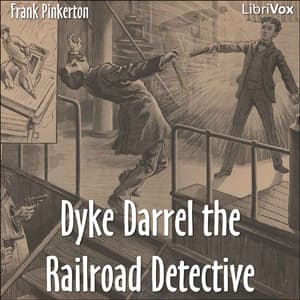

Okay, so I need to talk about why I spent four hours listening to a Victorian detective novel written by someone named A. Frank Pinkerton. (Yes, like the detective agency. No, I don't know if there's a connection. The research rabbit hole failed me.)
Here's what happened: I was making dal makhani - the real kind, the one that takes three hours - and I needed something to keep me company. Something that wouldn't require my full attention because, honestly, tempering spices demands respect. And this little melodrama? Perfect background companion. Until it wasn't background anymore.
The Psychology of a Victorian Manhunt
Dyke Darrel is a fascinating case study in how 19th-century writers understood justice and obsession. The premise is simple enough - train robbery, murdered friend, detective goes hunting. But what makes this character compelling is the way his investigation becomes personal in a way that Victorian fiction rarely acknowledged openly. This isn't just about solving a crime. It's about revenge dressed up in the respectable clothing of duty.
The author understands human nature in that specific way pulp writers sometimes do - not through nuance, but through amplification. Every emotion is turned up to eleven. Every villain is villainous. Every hero is heroic. And yet? There's something psychologically honest about that. We want to believe in clear moral categories. We want the bad guy to look like a bad guy.
My therapist would have thoughts about Dyke Darrel's inability to separate professional obligation from personal vendetta. Classic displacement behavior, honestly.
Sibella Denton Gets the Assignment
The narrator here is Sibella Denton, and she clearly understood what this material needed. This is melodrama. High Victorian serial melodrama, as she herself describes it. And she leans into that without making it feel like a joke.
Her tone has this quality - earnest but aware. Like she's inviting you into the absurdity while still respecting the story. The pacing works for the era and the genre. Though I'll say this: some of the character voices blend together a bit. When you've got multiple scheming villains in a scene, it can get muddy. Not a dealbreaker, but I noticed.
What I couldn't find much about was Denton's other work or background. Based on this performance alone, though, she's got a good instinct for period material.
When the Midnight Express Actually Delivers
At just over four hours, this doesn't overstay its welcome. Some listeners have complained about pacing in Victorian fiction generally, and I get it - these books were written for serialization, for drawing things out. But this one moves. There's a murder in the opening, a chase that spans multiple settings, and enough twists to keep you guessing.
Readers who enjoyed this also gravitated toward Conan Doyle and Wilkie Collins. Makes sense. Though if you want that pulpy intensity in a modern setting, Edge has that same relentless chase energy. But Pinkerton (whoever he actually was) has a pulpier edge. Less literary pretension, more pure entertainment.
I found myself asking: why does this detective really pursue this case with such intensity? The text says it's about his murdered friend. But the protagonist exhibits classic avoidant attachment patterns - he's more comfortable with the hunt than with grief. The crime gives him permission to feel something without having to name it.
Or maybe I'm overanalyzing a train robbery story. (My students would say yes. They're probably right.)
Who This Is (and Isn't) For
If you're into classic detective fiction and you've exhausted the obvious choices, this is a fun detour. It's public domain, it's short, and Denton's narration makes it easy to consume. Perfect for cooking, commuting, or any activity where you want entertainment that doesn't demand your full cognitive load.
Skip it if you need complex character development and moral ambiguity. The characters are archetypes. The morality is clear. The villain practically twirls his mustache.
But sometimes that's exactly what you want. Sometimes you just need the good guy to chase the bad guy through a Victorian landscape while a capable narrator guides you through. No deeper meaning required.
Case Closed (The Dal Was Worth It)
The dal turned out great, by the way. And I finished the audiobook while doing dishes afterward. That's the highest compliment I can give a mystery - it made me want to keep listening even when I didn't have to.