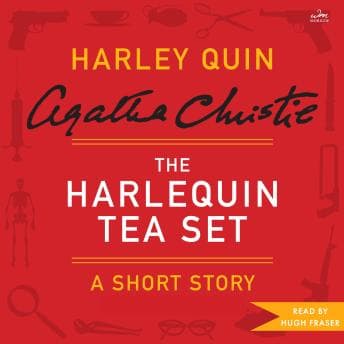

I was shelving returns in the mystery section last Tuesday — one of those quiet afternoons where the branch gets maybe three patrons and the fluorescent lights hum louder than any conversation — when I realized I had exactly seventy-one minutes before close. Perfect. I popped in my earbuds and let Hugh Fraser take me somewhere very different from small-town Oregon.
Christie's Strangest Detective Is Also Her Most Haunting
So here's the thing about the Harley Quin stories that most Christie fans sleep on: they're not really mysteries. Not in the Poirot sense, not in the Marple sense. They're closer to ghost stories wearing a mystery's clothes. Mr. Quin appears, seemingly from nowhere, bathed in light or shadow depending on the scene, and he doesn't solve anything himself. He just... illuminates. He asks the right questions. He makes old Mr. Satterthwaite — this fussy, observant, deeply lonely socialite — see what was already in front of him.
This understands that horror isn't about gore — it's about dread. That slow-burn wrongness is something Gillian Flynn does with a completely different toolkit in Dark Places — where the dread comes not from a mysterious stranger but from the rot inside a family that everyone agreed, decades ago, not to look at too closely. And I don't mean "The Harlequin Tea Set" is horror, exactly. But there's something genuinely uncanny about the way Quin operates. He walks into a café with a dog named Hermes (the messenger god, the guide of souls — Christie was not being subtle and I love her for it), drops the single word "Daltonism" like a grenade, and vanishes. The word means color blindness. That's the key to the whole mystery. A family member's inability to distinguish certain colors has masked what's really been happening with a set of harlequin teacups, and by extension, with a poisoning that everyone's been too polite to notice.
It's such a Christie move. The clue is medical, specific, almost clinical — but the delivery is pure supernatural theater.
Hugh Fraser Knows Exactly What Register This Story Lives In
Fraser is best known as Hastings from the Poirot TV series, and you can hear that DNA in his narration. His Satterthwaite has this wonderful quality of being simultaneously precise and bewildered — an elderly man who notices everything but understands nothing until Quin nudges him. There's a warmth there, a gentleness, that keeps you listening even when the plot is essentially Satterthwaite recounting a family's genealogy to a man in a tea shop.
And yes, the family history recitation section is padded. At seventy-one minutes, this story probably has about fifty minutes of actual plot. The middle stretch — where Satterthwaite lays out who married whom and who inherited what — drags in the way that only Christie exposition can drag. Fraser does his best to differentiate the various family members, but when you're running through three generations of country gentry in rapid succession, the voices blur.
I've seen some listeners mention difficulty understanding Fraser's delivery, and I get it — he's distinctly British in a way that doesn't always enunciate for clarity. His consonants can soften into each other during longer passages. But honestly? For this particular story, that slightly blurred, drawing-room quality works. Satterthwaite is a man of that world. He should sound like this.
The Seventy-One Minute Problem
Here's where I have to be honest with you. This is a short story. A single short story. Seventy-one minutes. And while it's a good one — genuinely clever, with that eerie Quin atmosphere that Shirley Jackson walked so Christie could... well, walk in a very different direction — it's hard to recommend spending a full credit on it. The "Daltonism" reveal is satisfying. The tea shop scene crackles with that strange energy Quin always brings. But the pacing sags in the middle, and the resolution, while elegant, doesn't have the gut-punch of Christie's best short work.
My podcast listeners are going to love this — specifically the ones who've been asking me to cover Christie's weird, quasi-supernatural side. Because the Quin stories ARE weird. They sit in this liminal space between cozy mystery and something much stranger, and "The Harlequin Tea Set" is one of the last Quin stories Christie ever wrote. You can feel her fondness for these characters. Satterthwaite is old now, genuinely old, and there's a melancholy to his reunion with Quin that gave me a pang I wasn't expecting from a story about teacups and color blindness.
Shrley (my cat, who had parked herself on my returns cart) was unimpressed. I was quietly moved. Different vibes.
Who Needs This and Who Doesn't
If you're a Christie completist or a Harley Quin fan, this is essential. Fraser's narration is warm and committed, and the story has a late-period Christie charm that rewards patience. If you're new to Christie, start literally anywhere else — Poirot, Marple, "And Then There Were None." This is dessert, not the main course. And if you're paying per credit, grab the full "Harlequin Tea Set and Other Stories" collection instead. This single story at full price is a tough sell.
The Lights Were Still On, But Something Flickered
I walked out of the library that evening thinking about color blindness as a murder weapon. About how Christie could take something so mundane and turn it into the hinge of a life-and-death mystery. About how Harley Quin is basically a supernatural being who just... helps an old man pay attention. That's strange and beautiful and a little bit creepy, and I'm still not over it.