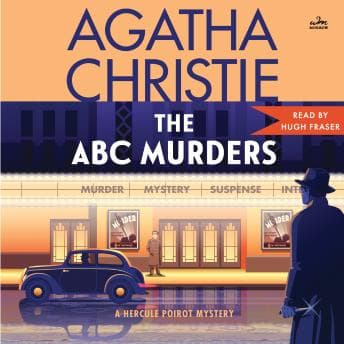

Look, I need to get something off my chest: Agatha Christie's plotting has no business being this tight nearly a hundred years after publication. I finished The ABC Murders on a late-night drive back from a client site in San Antonio, and I was genuinely irritated with myself for not seeing the twist coming. I've planned security operations with fewer moving parts than this woman's mystery architecture. A serial killer working alphabetically through English towns — Mrs. Ascher in Andover, Betty Barnard in Bexhill, Sir Carmichael Clarke in Churston — and the whole thing feels like a chess game where you're convinced you're three moves ahead. You're not.
The Captain Hastings Problem (And Why It's Not Actually a Problem)
Here's where this audiobook gets interesting. Hugh Fraser — the actual Captain Hastings from the ITV series — narrates the whole thing. And because Christie wrote this from Hastings' perspective, you're essentially getting the man himself telling you the story. Fraser doesn't do a Suchet impression for Poirot, exactly, but there's this clipped, slightly theatrical Continental precision he brings to the dialogue that feels right. It's close enough to make your brain fill in the rest. His natural register — that upper-class English public school delivery — IS Hastings, because he's been playing the man for decades. The warmth is genuine. When Hastings gets flustered or protective of Poirot's reputation, you hear it in Fraser's voice, this slight tightening, a touch of indignation.
What impressed me most was the working-class voices. Fraser distinguishes the murdered Mrs. Ascher's neighbors from the police investigators from the suspects with real precision. The class stratification in 1930s England comes through in how people talk, not just what they say. That's the kind of detail that separates a good narrator from someone just reading words.
Intelligence Work in Tweed
I've seen this scenario play out in real life — not the alphabetical murder part, obviously, but the pattern-recognition problem. When you're doing threat assessment, the hardest thing is distinguishing a real pattern from coincidence dressed up to look like one. Christie understood this instinctively. The ABC Railway Guide left at each crime scene, the taunting letters to Poirot — it all screams "I'm smarter than you" in a way that's designed to make investigators chase the wrong thread.
The chapter called 'Aladdin's Cave' has this quiet, chilling atmosphere that caught me off guard. Christie doesn't do gore or graphic violence — she doesn't need to. The menace is intellectual. You feel the net tightening, but you're not sure who's actually caught in it. And when Poirot finally assembles the suspects for the big reveal — yeah, it's a classic drawing room denouement, but Fraser delivers it with this building momentum that had me white-knuckling the steering wheel.
At six hours, the pacing is nearly perfect for a single road trip. No filler, no meandering subplots. Christie was economical in a way modern thriller writers could learn from. Every scene does work. Every character interaction plants something or pays something off. I noticed the opposite problem in State of Terror — plenty of character depth, but the plotting doesn't always earn the same respect.
Where the Armor Shows a Crack
Here's my one gripe, and it's minor: if you're coming to this completely cold, some of the character development feels thin. Hastings' narration gives you warmth but not always depth — the victims are sketched quickly, and a couple of the suspects feel more like chess pieces than people. That's partly Christie's style (she was always more interested in the puzzle than the psychology) and partly the constraint of a six-hour runtime. I didn't need more, but I could see someone wanting it.
Also — and this is a personal thing — the 1930s social attitudes pop up occasionally in ways that'll make modern ears twitch. Nothing extreme, but it's there. Context of the era.
Who's Getting Deployed on This One
If you like your mysteries cerebral and precise, this is your book. If you want car chases and body counts, you're in the wrong lane. This is intelligence work in tweed — observation, misdirection, and a detective who's always six steps ahead of everyone including the reader. Perfect for long drives, focused listening, or (as Linda would say) when you need something that won't wake the dog.
Ranger slept through the whole thing, which honestly might be the highest compliment — it means I wasn't yelling at plot holes.
Mission Debrief
The author clearly did their homework on human nature, and Fraser narrates like a man who's lived inside this world for thirty years. Because he has. Worth your time? Absolutely — especially if you've only seen the TV adaptations. The book is sharper, leaner, and that final reveal hits harder when it's just you and a voice in the dark. Mission accomplished.