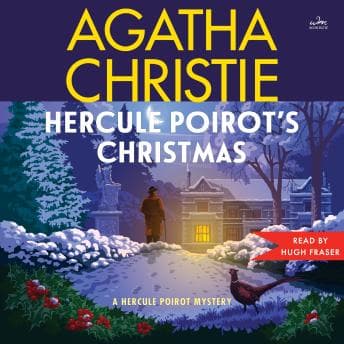

Everyone talks about Agatha Christie's clever plots. The locked rooms, the red herrings, the gotcha endings. And yes, she earned that. But here's what I think gets criminally overlooked about Hercule Poirot's Christmas: this is one of her sharpest psychological portraits of a dysfunctional family. Forget the murder for a second. The real violence in this book happens at the dinner table.
I came to this one late on a Sunday night, chopping onions for a chana masala I had no business starting at 10 PM. My mother would've approved of the cooking, disapproved of the murder. But the combination of Hugh Fraser's voice and the slow simmer of family resentment - both the literal and literary kind - kept me in the kitchen way past midnight.
Every Lee Is a Case Study in Inherited Damage
Simeon Lee is a patriarch who weaponizes his own children's need for approval. He's dying, he knows it, and instead of making peace, he summons the whole family to watch them squirm. The protagonist exhibits classic narcissistic grandiosity - even from his deathbed, the man needs to be the most powerful person in the room. Christie understood something about family dynamics that a lot of modern thrillers still get wrong: people don't murder strangers. They murder the people who raised them badly.
What makes this book fascinating as a case study in family psychology is the differentiation between the Lee siblings. Alfred, the dutiful son who stayed, radiates that particular brand of quiet resentment you see in adult children who sacrificed everything for a parent who never noticed. Harry, the prodigal, walks in with charm that barely conceals contempt. And then there's David's wife Hilda - my favorite character, honestly - who watches this entire family with the clear-eyed detachment of someone who married in and can see the dysfunction that everyone born into it is blind to. I found myself asking: why does Alfred really stay? Love? Duty? Or is it that he's built his entire identity around being the good son, and without that role, he doesn't know who he is?
Christie published this in 1938. She was writing attachment theory before Bowlby formalized it. No one can convince me otherwise.
Hugh Fraser Knows These People Personally (Or Acts Like It)
So there's this whole debate in Christie audiobook circles - Fraser vs. Suchet for Poirot narration. I've listened to both. Suchet obviously is Poirot in a way that's hard to compete with. But Fraser does something different and, I'd argue, sometimes better: he plays the ensemble. His Simeon Lee has this reedy, malicious quality - you can hear the old man enjoying the chaos he's causing. His Alfred is tight, clipped, controlled. When Harry arrives and Fraser shifts into this looser, more cavalier register, you immediately understand the sibling dynamic without Christie having to spell it out.
The murder scene itself - that crash, that scream described through Fraser's narration - lands hard precisely because he's been so measured leading up to it. At six hours, this is a tight listen. No padding. Christie was economical and Fraser matches that energy. He doesn't oversell the drama, which makes the dramatic moments actually dramatic. (My therapist would have thoughts about how much I appreciate emotional restraint in my fiction. We're working on it.)
One thing worth noting: there are no sound effects, no music, no production tricks. Just Fraser and Christie's text. And honestly? For a classic mystery, that's exactly right. You don't need atmospheric scoring when the writing already builds tension through dialogue and suspicion.
The Reveal Still Works - And Here's Why
I won't spoil it. But I will say this: the final revelation made me stop stirring my chana masala and just stand there. That specific feeling - where a story earns its ending through character rather than cheap surprise - is something I chased again in Machines Like Me, which also builds toward a reveal that lands because McEwan spent the whole book actually caring about why people do terrible things. Not because it's a shock-value twist, but because it's psychologically earned. When Poirot explains the motive, it tracks with everything Christie set up about how parents shape - and damage - the people their children become. The research actually shows that the most satisfying mystery endings aren't the most surprising ones; they're the ones that feel inevitable in retrospect. Christie knew this instinctively.
Psychologically, this doesn't track as just a whodunit. It's a story about inheritance - not money, though that's there too - but the inheritance of cruelty, resentment, and the desperate need to be seen by someone who was never going to look.
Who Gets an Invitation to the Lee Family Christmas
If you care about character motivation in your mysteries - if you want to understand why before who - this is your book. If you're a Christie completist who somehow skipped this one, fix that immediately. If you need car chases and chapter-ending cliffhangers every thirty seconds, this isn't built for you. It's a slow burn, a family dinner where every polite exchange is a loaded gun.
And if you grew up in a family where someone always had to be the peacemaker and someone else got to be the favorite? You'll recognize the Lee family. Uncomfortably well.
Priya's Clinical Notes
This is Christie at her most psychologically astute, narrated by someone who understands that the real mystery isn't behind the locked door - it's in the spaces between what family members say to each other and what they actually mean. I started this as a background listen and ended up completely absorbed. The chana masala turned out great, by the way. Unlike the Lee family, some things actually benefit from high heat.