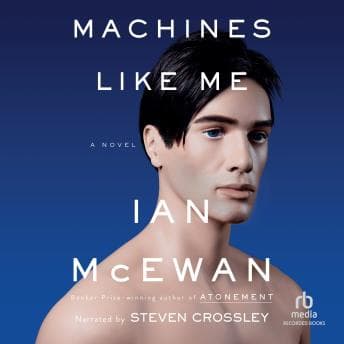

"The problem with the living is that they change. They're not the same from one hour to the next." Somewhere around hour three, Charlie delivers this observation about his synthetic human Adam, and I had to stop grading sophomore essays on The Great Gatsby to just... sit with that for a moment. Denise asked if I was okay. I wasn't sure.
McEwan has done something sneaky here. He's written what looks like a sci-fi novel about artificial intelligence, but what he's actually written is a meditation on moral absolutism versus the messy compromises that make us human. And he's set it in an alternate 1982 where Alan Turing never died, the Falklands went badly, and synthetic humans are suddenly available for purchase like high-end appliances. The audacity of this premise alone—I love it. My students would hate it.
When the Machine Becomes the Conscience
Here's what McEwan is really saying: What happens when you create a being with perfect moral clarity and then force it to live among humans who are constitutionally incapable of such clarity? Adam, our synthetic protagonist, isn't a villain. He's not HAL 9000. He's something more unsettling—he's right. About almost everything. And watching Charlie and Miranda squirm under the weight of that rightness is genuinely uncomfortable listening.
The love triangle that develops isn't really about romance, though there's that too. It's about who gets to define ethical behavior. Miranda carries a secret—I won't spoil it—that she believes was morally justified. Adam's silicon-based brain cannot compute this justification. And Charlie, poor drifting Charlie, is stuck between the woman he loves and the machine he bought with his inheritance.
This reminds me of what Hemingway said about writing—that the dignity of movement of an iceberg is due to only one-eighth of it being above water. McEwan keeps so much submerged here. The alternate history stuff—Thatcher vs. Benn, a living Turing, the Beatles reuniting—could easily overwhelm the narrative. Instead, it's texture. Background radiation. The real story stays intimate, claustrophobic even.
Steven Crossley Understands That Pause Is Punctuation
I listened at 1.0x because the prose deserves to be savored, and Crossley's narration rewards that patience. He's doing something subtle that I didn't fully appreciate until about hour six: he reads Adam's dialogue with almost imperceptible precision. Not robotic—that would be too obvious. Just... cleaner. More measured. The contrast with Charlie's slightly messier internal monologue creates an audio distinction that's easy to miss if you're speeding through.
Crossley won an AudioFile Earphones Award for this, and I understand why. This is classic British literary narration—detached, worldly, never overselling the emotional moments. Some listeners might find it too cool, too removed. I found it perfect for McEwan's prose, which already does plenty of emotional heavy lifting without needing a narrator to underline every revelation.
The character differentiation is subtle rather than theatrical. You won't get wildly different voices for each character. What you get is tonal shift—slight changes in register that signal who's speaking without breaking the narrative flow. Worth pausing the faculty meeting for. (Not that I was listening during Principal Martinez's curriculum presentation. I definitely wasn't.)
The Turing Problem
The alternate history's masterstroke is keeping Turing alive. McEwan gives us a Turing who achieved his AI breakthrough and now grapples with what he's unleashed. There's a scene—I won't timestamp it because I genuinely lost track of where I was in the lakefront walk—where Turing appears and the weight of his creation's implications lands with full force. It's not action. It's conversation. But Crossley reads it like the philosophical reckoning it is.
My one frustration: the ending feels rushed relative to the careful construction of everything before it. After eleven hours of meticulous moral architecture, the final hour makes choices that felt—to this English teacher who's read too much Dostoevsky—slightly too neat. The questions McEwan raises deserve messier answers than they receive.
Who Should Listen (And Who Should Run)
If you loved Never Let Me Go by Ishiguro, this is its spiritual successor—same quiet devastation, same questions about what constitutes a soul. All the Light We Cannot See operates in that same register—historical setting, philosophical weight, prose that demands your full attention. If you want robots fighting or techno-thriller pacing, you will be bored. This is a novel of ideas that happens to have a robot in it.
Not for multitasking. Not for the gym. This demands focus—the kind of listening you do late at night when the grading is done and you can actually think. I finished it at 11 PM with a glass of bourbon and a lot of uncomfortable thoughts about moral certainty.
Mr. Williams's Final Grade
McEwan has written something that's going to age well. The AI questions he's asking in this alternate 1982 are the exact questions we're stumbling through now, and he saw them coming. Crossley's narration serves the text with intelligence and restraint.
Is it perfect? No. The ending wobbles. Some of the alternate history details feel like showing off rather than serving story. But the central question—can a machine understand the human heart, and would we want it to?—that's going to stick with me for a while.
Worth a credit. Worth the eleven hours. Just don't listen while pretending to pay attention to anything else.