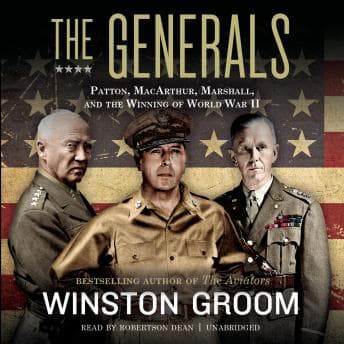

What do you do with three men who couldn't stand each other but collectively saved the free world?
That's the question I kept turning over during a Saturday lakefront walk with Denise — one of those late-autumn Chicago mornings where the wind off the lake makes you question every life choice except the one to keep walking. We were supposed to be talking about Thanksgiving plans. Instead I had one earbud in, listening to Winston Groom untangle the lives of Patton, MacArthur, and Marshall, and every few minutes I'd stop and say something like "Did you know MacArthur's mother literally moved to West Point to watch him from a hotel window?" Denise is a patient woman.
The Forrest Gump Guy Wrote a War Book (And It's Actually Good)
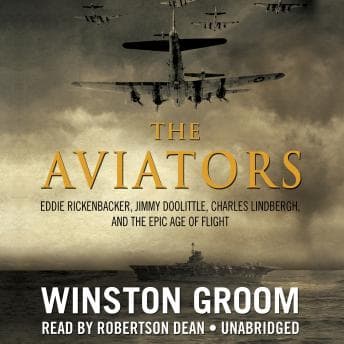
Let's get this out of the way: yes, this is the Winston Groom who wrote Forrest Gump. And no, this isn't some celebrity-author cash grab. Groom was a legitimate military historian — a Pulitzer finalist for Conversations with the Enemy — and you can feel the research here. What surprised me is how novelistic the structure is. Groom doesn't write three separate biographies stapled together. He braids them, starting from World War I, where all three men were forged in the same brutal crucible of the Meuse-Argonne offensive, then follows the threads as they diverge and reconverge across three decades.
The real discovery for me was George Marshall. I teach American literature, not American history, but I've absorbed enough cultural mythology to know the broad strokes of Patton (tank-obsessed madman, slapped a soldier, George C. Scott played him) and MacArthur (corncob pipe, "I shall return," ego the size of the Pacific Theater). Marshall, though? The man who essentially orchestrated the entire American war effort from Washington, managed two of the most volatile personalities in military history, and then designed the plan that rebuilt Europe — and he's the one nobody makes movies about. Groom clearly loves this irony. He positions Marshall as the quiet fulcrum between two spectacular egos, and it works.
Patton gets the most colorful material, naturally. The man believed in reincarnation, wrote poetry, wept openly, and once stood up in his jeep during an air raid because he thought it was undignified to duck. MacArthur gets the most complex treatment — Groom doesn't shy away from his vanity or his questionable decisions in the Philippines, but he also doesn't reduce him to a caricature. There's a genuine attempt to understand why MacArthur was the way he was, and that mother-at-West-Point detail is just the beginning of a deeply strange family dynamic.
Robertson Dean and the Art of Not Overdoing It
Robertson Dean narrates at 1.0x — my speed, the correct speed, I will die on this hill — with the kind of steady, authoritative delivery that military nonfiction demands. He's not doing voices, and he shouldn't be. This isn't a novel. But there's a subtle thing he does with Patton's quotes that I appreciated: he drops into this slightly gruff, clipped register that captures Patton's theatrical intensity without turning it into a Saturday Night Live impression. It's the difference between interpretation and impersonation, and Dean lands on the right side.
The pacing varies well across sixteen hours, which is important because Groom's structure means you're sometimes jumping between theaters of war, sometimes sitting through political maneuvering in Washington, and sometimes reading what amounts to personal correspondence. Dean adjusts. The battle sequences move. The political sections breathe. I never felt like I was fighting to stay engaged, which — for a sixteen-hour history audiobook listened to partly while grading sophomore essays on The Great Gatsby at 11 PM — is high praise.
The Part Where I Get Honest About the Gaps
Here's what kept nagging me: Groom covers an enormous amount of ground, and sometimes breadth wins over depth. The World War I sections feel rushed compared to the World War II material, which is a shame because the WWI experience is supposedly the crucible that shaped all three men. I wanted more time there. And while the triple-biography structure is clever, it means no single general gets the deep psychological excavation you'd find in, say, Rick Atkinson's work on the European theater or William Manchester's American Caesar on MacArthur alone.
If you loved David McCullough's biographical work — his ability to make historical figures feel like people you might actually know — this is its spiritual successor, though Groom is a bit more interested in military strategy and a bit less interested in domestic life.
Who's Raising Their Hand for This One
Military history buffs will find this comfortable and engaging, though probably not revelatory. But the real audience, I think, is people like me — readers (listeners) who know the names but not the stories, who want the connective tissue between these three legends without committing to three separate 800-page biographies. It's a gateway drug to deeper reading. I had a similar feeling finishing K2: Life and Death on the World's Most Dangerous Mountain — that specific itch where the book ends and you immediately want three more books on the same subject.
My students would hate this. I love it. (Though I'd settle for them just finishing Gatsby.)
Worth Pausing the Faculty Meeting For
Sixteen hours is a commitment, but Groom earns most of them. Robertson Dean delivers the kind of steady, intelligent performance that lets you forget you're being read to. It's not perfect — the early sections needed more room to breathe, and Groom occasionally falls into the trap of telling you someone was remarkable instead of showing you why. But when it works, and it mostly does, you get something rare: a military history that reads like a novel about friendship, rivalry, and the strange alchemy of leadership. The prose deserves to be savored. This is why we still read — and listen to — the classics of American history.



![Steve Jobs [unabridged audiobook] audiobook cover](/_next/image?url=https%3A%2F%2Fcovers.audiobooks.com%2Fimages%2Fcovers%2Ffull%2F9788499923406.jpg&w=1920&q=75)