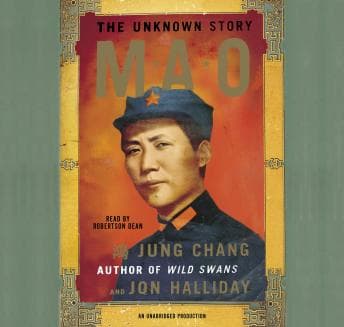
Seventy million people. In peacetime.
I finished the last chapter of this book on a Tuesday morning, sitting in my car in our driveway, engine off, not ready to go inside and make pancakes. Carlos texted me asking if I'd gotten home okay. I told him I needed a minute. He assumed traffic. It wasn't traffic.
I came to this one because I'd read Wild Swans years ago - actual paper copy, dog-eared, passed around my nursing school cohort like contraband. Jung Chang writing about Mao with her husband Jon Halliday felt like a natural next step. What I didn't expect was nearly thirty hours of feeling like the ground was shifting under me.
This is not a rehabilitation project. It's closer to a prosecution.
The Numbers Don't Lie, But Historians Sometimes Do
Here's what Chang and Halliday do that I wasn't prepared for: they go after the myths systematically. The Long March - that legendary revolutionary exodus that's been taught as the founding story of modern China - gets taken apart piece by piece. The idealism, the peasant hero narrative, the man-of-the-people mythology. Gone. What replaces it is a portrait of someone who welcomed Japanese occupation because it weakened his rivals, who used starvation as a policy instrument, who kept meticulous score of every slight and settled every account eventually.
As someone who's spent fifteen years watching people make life-and-death decisions under pressure, I can tell you: there's a specific kind of cold that comes over you when you recognize a pattern of deliberate harm versus negligent harm. This book made me feel that cold for thirty hours straight. Mao wasn't making desperate choices in impossible circumstances. He was engineering the circumstances to produce specific outcomes. The famine that killed 38 million people during the Great Leap Forward wasn't a policy failure. Chang and Halliday argue, with documentation, that Mao knew. Continued grain exports anyway. That detail sat with me through two full commutes and I still haven't fully metabolized it.
The research here is genuinely staggering - a decade of interviews with people from Mao's inner circle who'd never spoken before. You feel the weight of that access throughout. This isn't a book built on secondary sources and educated inference. It's built on people who were in the room.
I should note: this book is not without its critics in academic circles. Some historians have pushed back on specific interpretations and sourcing. I'm a nurse, not a China scholar, so I can't adjudicate those debates. What I can say is that the argument is presented with enough specificity that you can follow the reasoning, and the sheer volume of primary sourcing is visible throughout.
Robertson Dean Is Doing Real Work Here
Twenty-nine hours and fifty-one minutes is a commitment. I want to be honest about that upfront. This is not a book you put on while folding laundry. I tried that once, around hour six, and realized I'd folded the same shirt four times while trying to track a section on Mao's relationship with Stalin in the 1920s. This requires actual listening.
Robertson Dean's baritone is steady and controlled in a way that works specifically for this material - he doesn't editorialize, doesn't let horror bleed into his delivery, which somehow makes the horror land harder. When he's reading casualty figures or describing what happened in particular villages during the famine, the evenness of his voice becomes its own form of weight. You can't hide from the numbers behind a dramatic reading.
The one real issue: Chinese pronunciations. He's not using contemporary pinyin conventions consistently, which means some names sound slightly off if you have any familiarity with Mandarin pronunciation. It's not constant, and most Western listeners probably won't notice. But it's there, and it pulled me out occasionally.
Still. For nearly thirty hours of dense historical biography, he holds the line. That's not nothing.
Before You Queue This Up
My mom - who still thinks I should've been a doctor and has opinions about everything I read - asked me what I was listening to last week. I described it. She went quiet for a moment and then said, "That's a heavy thing to carry home from a night shift."
She's not wrong. This is not decompression listening. This is not the book for the drive home after a rough code when you need something that won't demand anything from you. I made that mistake around hour twelve and had to pull over.
This is for the days when you have bandwidth. When you want to understand something enormous and terrible and real. When you're ready to sit with the question of how a single person's appetite for power can become a number like seventy million.
If you read Wild Swans and wanted to follow Chang further into this history - yes. I had a similar experience moving between big political biographies - American Lion: Andrew Jackson in the White House does something comparable with the mythology around Jackson, though the scale of what Chang and Halliday are dismantling here is in a different category entirely. If you've read other Mao biographies and want something that challenges the standard narrative directly - absolutely yes. If you're new to Chinese twentieth-century history and want a starting point - maybe start with Wild Swans first, get your footing, then come back.
If you need something lighter right now? No judgment. Come back to this one when you're ready. It'll wait.








![Steve Jobs [unabridged audiobook] audiobook cover](/_next/image?url=https%3A%2F%2Fcovers.audiobooks.com%2Fimages%2Fcovers%2Ffull%2F9788499923406.jpg&w=1920&q=75)