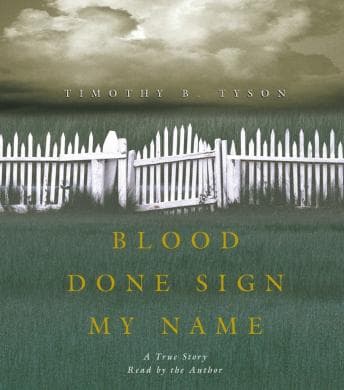

I was up at 2 AM finishing a logo redesign for a client who keeps saying "make it pop" (sir, please), and I had this playing through my over-ear headphones because I needed something to anchor me to something real while I pushed pixels around. And then Timothy Tyson described Henry Marrow being chased down and killed in broad daylight in front of witnesses in 1970 — not 1870, 1970 — and I stopped working. Just sat there. Frida jumped on my lap like she knew.
This book felt like getting hit in the chest with something you already suspected but never wanted to look at directly.
The Pastor's Son Who Couldn't Look Away
Here's what makes this different from a straight civil rights history: Tyson is writing about his own town, his own childhood, his own father. His dad was the white Methodist pastor in Oxford, North Carolina, who tried to push his congregation toward racial reconciliation after the Marrow murder — and got pushed out for it. Tyson was a kid when all of this happened. He played with Black kids in the neighborhood. He watched the tobacco warehouses burn. He saw his family get forced out of town for doing the bare minimum of being decent.
So this isn't a historian parachuting into a historical event. This is someone excavating his own backyard. And that tension — between the academic rigor Tyson brings (he's a Duke historian) and the raw, personal grief of a boy who watched his town tear itself apart — that's what gives the book its particular ache. William Cronon does something similarly disorienting in Changes in the Land — that same quality of a scholar refusing to let academic distance become emotional distance, making you feel the full weight of what the evidence actually means. He toggles between these modes: one minute you're getting careful legal analysis of how the all-white jury acquitted Robert Teel and his sons despite the murder being PUBLIC, and the next you're in the living room with Tyson's family as they process what it means to be white people in a town that chose silence over justice.
The Teel acquittal scene — I can't get it out of my head. Tyson lays it out with this cold precision that somehow makes it worse. The evidence was overwhelming. The killing happened in front of people. And the system just... shrugged.
Robertson Dean Carries Twelve Hours Like It's Nothing
Okay, so I didn't know much about Robertson Dean going in, and the research I found was pretty thin on specifics about his performance here. What I can tell you from twelve hours of listening: the man has a voice that's warm but never soft in a way that lets you off the hook. He reads Tyson's anger and Tyson's tenderness with the same steady gravity, and that consistency is actually what makes both hit harder. There's no vocal theatrics, no dramatic pauses that scream FEEL SOMETHING NOW. He trusts the material.
I will say — and this is where I wish I had more specifics to share — I would've loved to hear more vocal distinction between the voices Tyson channels, especially the Black veterans and community members versus the white townspeople. With a single narrator handling a story this populated with real people, that differentiation matters. Dean doesn't do anything wrong, exactly. But there were stretches where I wanted the voices to feel more embodied, more distinct from each other. For a twelve-hour listen, that's a lot of time spent parsing who's speaking.
Still. The emotional weight he brings to the quieter passages — Tyson reflecting on his father's moral courage, or the moments where he grapples with his own whiteness — that delivery is genuinely superb. I believed every word.
Abuela Would Have Clutched Her Rosary and Then Marched
My abuela grew up in a world where systems told her she was less than. Different systems, different specifics, but the architecture of it — the way power protects itself, the way "good people" stay silent because silence is comfortable — she would have recognized all of it. She wouldn't have let me look away from this book. She would've made me sit with it.
Tyson does something brave here that I want to name: he doesn't let white liberals off the hook. His own family, who were genuinely trying to do right, still benefited from the structures that killed Henry Marrow. He's honest about that. It's not a comfortable book and it shouldn't be.
I ugly-cried during the section about the Black community's response to the acquittal — the rage, the grief, the burning. Not because destruction is heroic but because Tyson makes you feel the absolute suffocation of having no other outlet when every legal and social channel has been sealed shut against you.
Who This Is For (and Who Should Brace Themselves)
If you want civil rights history that reads like memoir and hits like gospel, this is your book. If you loved The Warmth of Other Suns or Just Mercy, this lives on that shelf. If you need your history sanitized or wrapped in a neat redemption arc — skip it. Oxford didn't get redeemed. The Tysons left. The truth just sat there, ugly and unresolved.
This is a focused-listening book. Do not put this on while meal prepping. Give it your full attention. It earned it.
The Kind of Book That Changes Your Posture
I finished at 3:47 AM. Didn't go back to the logo. Just sat in my dark apartment with two sleeping cats and thought about what it costs to tell the truth in a town that doesn't want to hear it. My heart. MY HEART. Some books entertain you. Some books rearrange something inside your chest. This one did the second thing.





![Steve Jobs [unabridged audiobook] audiobook cover](/_next/image?url=https%3A%2F%2Fcovers.audiobooks.com%2Fimages%2Fcovers%2Ffull%2F9788499923406.jpg&w=1920&q=75)