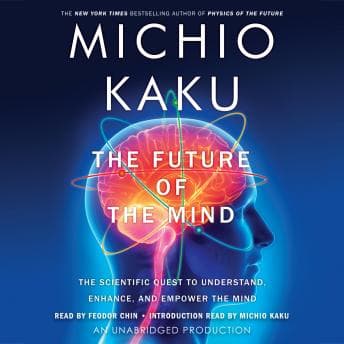

Halfway through a cross-country flight, somewhere over Kansas, I found myself genuinely unsettled—not by turbulence, but by the realization that scientists can already record and play back memories in mice. Michio Kaku has this gift for taking bleeding-edge neuroscience and making you feel like you're reading tomorrow's headlines today.
Kaku structures this 15-hour journey as a grand tour of consciousness itself, starting with the basics of how the brain works before launching into increasingly wild territory: telepathy experiments that actually work, brain-computer interfaces that let paralyzed patients move robotic arms, and the theoretical possibility of uploading human consciousness to computers. What struck me most was how grounded everything feels despite the sci-fi subject matter. Kaku doesn't just speculate—he visits labs, interviews researchers, and traces the actual science behind each breakthrough.
A Physicist's Framework for Consciousness
The physicist brings his signature accessible style to neuroscience, a field that could easily become impenetrable to general audiences. He introduces a clever framework for understanding consciousness that ranks it on a scale from simple awareness (like a thermostat) to self-awareness and the ability to simulate future scenarios. Mindful Athlete explores a different angle on consciousness—how elite performers access flow states by quieting the analytical mind. It's the kind of mental model that sticks with you and reshapes how you think about everything from animal intelligence to artificial minds.
Feodor Chin's Measured Delivery
Here's where I have to be honest about the listening experience. Feodor Chin narrates with crystal-clear enunciation and steady pacing that makes the complex material easy to follow. His pronunciation of scientific terminology is spot-on, and the production quality is flawless—no background noise, no volume inconsistencies. But there's a flatness to the delivery that becomes noticeable over fifteen hours. When Kaku describes something genuinely mind-blowing, like the possibility of a 'brain-net' that could transmit thoughts and emotions globally, Chin reads it with the same measured tone he uses for everything else.
This isn't a dealbreaker, but it does require the right listening context. I found the audiobook worked best during focused activities—long drives, cleaning the house, walking the dog—where my brain was engaged enough to supply its own excitement to the material. Trying to listen while drowsy or distracted made the monotone delivery harder to push through. Some listeners have described it as tedious, and I understand that reaction, though I'd argue the content itself is so fascinating that it carries the experience.
2014 Predictions vs. Today's Reality
What Kaku does exceptionally well is balance current reality with future possibility. He'll explain an existing technology—say, fMRI scans that can detect which image a person is looking at—and then extrapolate where this could lead in twenty or fifty years. The book was published in 2014, and it's genuinely interesting to note which predictions are already coming true and which remain on the horizon. This gives the audiobook a sense of ongoing relevance rather than feeling dated.
The chapters on mental illness and consciousness offer some of the book's most affecting moments. Kaku approaches conditions like schizophrenia and depression through the lens of brain architecture, suggesting that future treatments might involve targeted interventions rather than the blunt instruments of current medication. It's a mechanistic view of the mind that contrasts sharply with the interpersonal mysteries explored in Talking to Strangers, where Gladwell examines how we misread each other's mental states in social contexts. There's real hope in these sections, grounded in scientific plausibility rather than wishful thinking.
I should mention that Kaku occasionally ventures into speculative territory that some scientists might find too optimistic—particularly around timelines for technologies like mind uploading. He's upfront about this, framing these discussions as possibilities rather than certainties, but listeners who prefer strictly conservative scientific takes should calibrate their expectations.
Where Physics Meets Neurons
The audiobook shines brightest when Kaku connects disparate ideas across physics, biology, and philosophy. His background as a theoretical physicist gives him a unique perspective on the brain as an information-processing system, and he draws fascinating parallels between quantum mechanics and neural computation. These interdisciplinary moments feel genuinely fresh.
Who Should Queue This Up (And Who Should Skip)
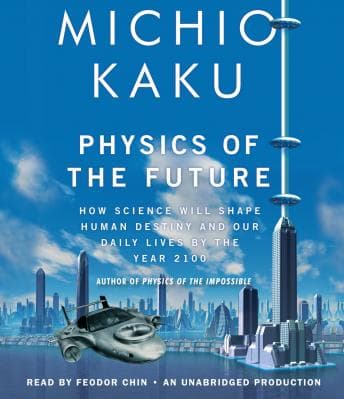
For fans of popular science, particularly those who've enjoyed Kaku's other works like Physics of the Future or books by authors like Carl Sagan and Neil deGrasse Tyson, this is essential listening. The content is rich enough to reward multiple listens, and despite the narrator's neutral delivery, the ideas themselves provide plenty of intellectual stimulation. Skip this one if you need an animated narrator to stay engaged, or if speculative science frustrates you more than it excites you.
My Prescription for Optimal Listening
If you're sensitive to narration style, sample the audiobook first or consider bumping the speed to 1.25x, which adds some energy to Chin's delivery without sacrificing clarity. But if you're the type of listener who can engage with ideas regardless of vocal performance, this is a fascinating window into where neuroscience is headed—and what it might mean for humanity's future.








![Steve Jobs [unabridged audiobook] audiobook cover](/_next/image?url=https%3A%2F%2Fcovers.audiobooks.com%2Fimages%2Fcovers%2Ffull%2F9788499923406.jpg&w=1920&q=75)