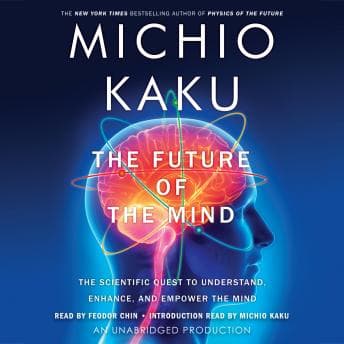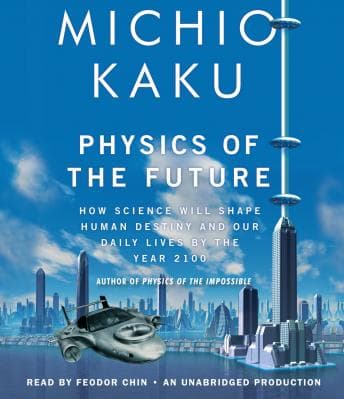

"In all likelihood, by 2100 we will control computers via tiny brain sensors and, like magicians, move objects around with the power of our minds."
I was chopping onions when Feodor Chin read this sentence to me. (Yes, I was making a curry base; no, I didn't use the food processor because I needed the catharsis.) I stopped mid-chop. The idea is terrifying. Fascinating, sure—but terrifying.
Michio Kaku isn't writing sci-fi here. He's interviewing 300 scientists to build a roadmap for the next century. It's ambitious. It's brilliant. But listening to it felt like a tug-of-war between my fascination with the concepts and my struggle with the delivery. The classic conflict: intellectual desire to know versus physiological need to stay awake.
The Professor is In (But He Talks Slow)
Let's address the elephant in the audio booth. Feodor Chin.
Look, his voice is nice. Smooth. Deep. The kind of voice you want reading you a bedtime story about bunnies, not a breakdown of nanotechnology and artificial intelligence. Though I will say, Chin absolutely shines in Hotel on the Corner of Bitter and Sweet—his pacing works beautifully for emotional, character-driven storytelling. Here? The pacing is—how do I put this politely?—deliberate.
Actually, forget polite. It's slow.
I usually listen at 1.0x speed because I like to savor the language (and because I'm usually gasping for air on a treadmill). But for this? I had to crank it up to 1.5x just to feel like we were having a normal conversation. At normal speed, it felt like a lecture in a warm auditorium after a heavy lunch. You know the feeling. Your eyelids get heavy, you start zoning out, and suddenly you've missed the invention of the space elevator.
Compare this to something like The Martian—where the science is punchy and the narration has grit—and this feels very... sterile. Clean, but lacking the chaotic energy of actual discovery. My therapist would say I'm projecting my need for chaos onto a physics book. She's probably right.
High Tech, Same Old Human Mess
Here's where the psychologist in me gets annoying. (I can hear my students groaning already.)
Kaku does a phenomenal job explaining how we will live. Internet contact lenses? Check. Magnetic cars? Check. Reversing aging? Scary, but check. He synthesizes complex physics into stuff that actually makes sense to a layperson. He respects the audience's intelligence without drowning us in jargon.
But—and it's a big but—he seems painfully optimistic about the why.
He describes a future where technology solves our problems. But as someone who studies narrative identity, I kept asking: Okay, but will we still be jealous? Will we still have identity crises? If we live to be 150, that's just more time to make bad relationship choices. Kaku focuses on the hardware of the future; I found myself missing the software—the messy, irrational human psychology that will be using these god-like powers.
We might have the power of gods, as he says, but we'll still have the emotional maturity of cavemen. This is exactly the kind of developmental gap explored in Adult Children of Emotionally Immature Parents—how we can be technologically advanced (or chronologically adult) while remaining emotionally stunted. That contrast? That's where the real story is. Kaku touches on it—he calls it the Caveman Principle—but he brushes past the social implications way too fast for my taste.
The Prescription
So, should you listen to it?
If you want to feel smarter than everyone else at a dinner party: Yes. Absolutely. The material is gold. You'll walk away with facts about antimatter rockets that will make you sound like a genius. Science enthusiasts who want a comprehensive tour of emerging technologies—this is your syllabus.
But if you need narrative momentum to stay engaged, or you're hoping for deep dives into how these changes will reshape human relationships and identity? You'll find yourself wanting. Skip it if slow-paced nonfiction puts you to sleep, or if you're looking for the philosophical implications rather than the technical possibilities.
I finished it during a long Sunday meal prep, and by the end, I felt hopeful but exhausted. It's a dense listen. It demands your attention, even if the narrator tries to lull you into a coma. Just do yourself a favor: find that speed button. Your brain (and your patience) will thank you.









![Steve Jobs [unabridged audiobook] audiobook cover](/_next/image?url=https%3A%2F%2Fcovers.audiobooks.com%2Fimages%2Fcovers%2Ffull%2F9788499923406.jpg&w=1920&q=75)