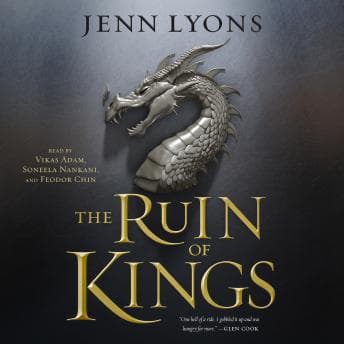

Twenty-seven hours. That's basically my entire commute for two and a half weeks, and I spent every single minute of it confused in the best possible way.
Bottom Line: Worth your commute. But maybe not your 6AM half-asleep commute. This one needs your brain firing on at least three cylinders.
Your Brain Will Hurt (In a Good Way)
So here's the thing about The Ruin of Kings that nobody warned me about: the structure is absolutely unhinged. You've got multiple timelines, unreliable narrators commenting on each other's accounts, and a protagonist who's simultaneously a street thief AND a prince AND possibly the prophesied destroyer of worlds. Jenn Lyons basically said "what if I wrote a fantasy epic but made it feel like you're piecing together a crime scene investigation?" and honestly? It works.
The three narrators—Feodor Chin, Soneela Nankani, and Vikas Adam—aren't just reading different chapters. They're playing different perspectives, sometimes contradicting each other, sometimes filling in gaps the other narrator deliberately left out. It's like listening to three people argue about what really happened at a party, except the party involves dragons, demons, and political assassinations.
Three Voices, Slightly Uneven Mix
Okay, let me be real here. Vikas Adam and Soneela Nankani absolutely crush it. Adam's got this range that lets him slip between Kihrin's street-smart sarcasm and the formal aristocratic tones of the Quuros nobility without missing a beat. Nankani brings this depth to the female characters that makes you forget you're listening to one person voice multiple women with completely different agendas.
Feodor Chin, though—and I feel bad saying this because his comedic timing on the footnotes and asides is genuinely funny—sometimes gets overshadowed. When you put him next to the other two, there's this slight imbalance in vocal range. It's not bad, exactly. Just noticeable. Like when you're debugging and one service is running at 80% efficiency while the others hit 95%. It still works, but you notice the gap.
The switching between narrators works smoothly though. They complement each other in a way that actually elevates the whole unreliable narrator gimmick. You start picking up on whose version of events you trust more, and that becomes part of the experience.
Perfect For: Long Road Trips. Skip For: Background Listening
I made the mistake of trying to listen to this while reviewing some code, and I had to rewind like four times in twenty minutes. This is NOT a background book. The world-building is dense—we're talking multiple kingdoms, a complex magic system, gods who are actually walking around causing problems, and a prophecy that keeps getting recontextualized every few chapters.
But on my actual commute? When I was awake and paying attention? I finished this in about 12 commutes and honestly wanted more. The pacing is weird in a way I ended up loving—it's slow-burn in terms of understanding what's actually happening, but individual scenes move fast. Lots of action, lots of political maneuvering, lots of "wait, THAT character is actually THAT character?" moments.
Kevin asked me to explain the plot and I talked for twenty minutes and he still didn't understand who the main villain was. (To be fair, I'm not sure I do either. That's kind of the point.)
Queue It If You Love Puzzle-Box Fantasy
If you loved Malazan but wished it was slightly more accessible—this is your jam. Theft of Swords hits that same sweet spot of complex-but-not-impenetrable worldbuilding, though with a lighter touch on the timeline gymnastics. If you're the type who reads wiki pages after finishing fantasy books to make sure you caught everything—you'll be in heaven. If you like your protagonists a little morally gray and your prophecies a lot more complicated than "chosen one saves world"—Kihrin's your guy.
Skip if: you need linear storytelling, you listen while doing other things, or you're not in the mood to work for your fantasy. This book does not hold your hand. It barely acknowledges you're there.
The ROI Calculation
Twenty-seven hours is a significant investment. But here's the thing—I'm already eyeing book two. The ending doesn't wrap things up neatly (fair warning: mild cliffhanger energy), but it recontextualizes enough of what you just listened to that I immediately wanted to understand more. That's the sign of a series that's going to pay off.
The production quality is clean, no weird audio glitches, and the three-narrator format actually justifies its existence instead of feeling gimmicky. For a debut novel that won all those 2019 "best of" lists, it lives up to the hype. Mostly.
I'm giving it 4 stars because the complexity occasionally tips into frustrating, and Chin's narration being slightly outmatched by his co-narrators is a real (if minor) issue. But this is absolutely worth a credit. Just... maybe bump it up to 1.25x during the slower political sections. Your commute will thank you.