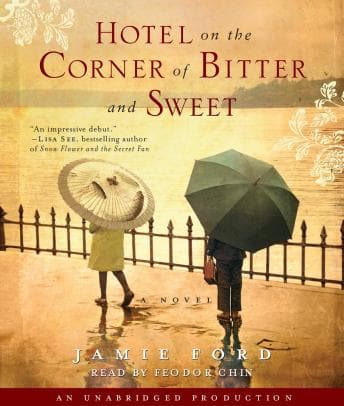

I was designing a book cover for a client—something about generational trauma, ironically—when Feodor Chin's voice hit me with Henry Lee standing outside that boarded-up hotel. And I just... stopped working. Sat there with my stylus hovering over my tablet like an idiot while this man's memories poured through my headphones.
Abuela would have loved this one. She had this thing about forbidden love stories, the ones where the world says no but the heart says yes anyway. Henry and Keiko's story is exactly that—a Chinese American boy and a Japanese American girl falling for each other in 1940s Seattle, when their own communities were at war and America was about to tear them apart anyway.
The Voice That Carries Forty Years
Feodor Chin. I need to talk about Feodor Chin. His voice is this warm, clear thing that somehow ages and de-ages without a hitch. One moment you're hearing twelve-year-old Henry discovering jazz with Keiko in the basement of a Black nightclub (yes, really, and it's beautiful), and the next you're with sixty-something Henry, carrying decades of regret in every syllable. The man is agile. That's the word. He shifts between tender and tense without ever breaking the spell.
His character voices are subtle but distinct. Henry's father—cold, traditional, heartbreaking—sounds different from the kind Black musicians who take the kids under their wing. And Keiko? She sounds like hope. Like the kind of first love that ruins you for everyone else because nothing will ever be that pure again.
I will say—and look, this is minor—there are some Japanese phrases that sound slightly off. Whether that's intentional (Henry is Chinese American, after all, learning Japanese) or just a limitation, I couldn't tell you. It didn't pull me out. But if you're fluent, you might notice.
Where History Becomes Personal
Here's the thing about historical fiction that works: it makes you feel the history, not just learn it. Jamie Ford does something really smart here. He doesn't lecture you about Japanese internment camps. He shows you Keiko's family losing everything—their home, their business, their dignity—while Henry watches helplessly. He shows you the "I Am Chinese" buttons that Chinese Americans wore so they wouldn't be mistaken for the enemy. The cruelty is quiet and bureaucratic, which somehow makes it worse.
The dual timeline structure (1986 and 1940s) could have felt gimmicky, but it works because the emotional stakes are clear in both. In the past, you're watching two kids fall in love against impossible odds. In the present, you're watching an old man try to make peace with the choices he made—or didn't make—when he was too young to know better.
I ugly-cried at chapter 24. And again somewhere around 28. (I lost track. The cats judged me.)
The Slow Ache That Pays Off
This is not a fast book. If you're looking for plot twists and thriller pacing, this isn't it. It's a slow burn in the truest sense—the kind where the tension builds through small moments. A shared umbrella. A record played in secret. A promise that might be impossible to keep.
Some listeners have said the writing feels clunky in places, and honestly? I get it. There are moments where Ford tells you what characters are feeling instead of letting you figure it out. But Chin's narration smooths over those rough edges. He finds the emotion in every line, even the ones that read a little flat on paper.
The relationship between Henry and his son Marty in the present timeline could have used more development. It's there, it's meaningful, but it feels like Ford was more interested in the past than the present. Which, fair. The past is where the heartbreak lives.
This Is a Rainy Sunday Book
I listened to this over three days while working, and I kept finding excuses to keep my headphones on. Just one more chapter while I adjust these kerning settings. One more while I wait for the client to respond. One more because I need to know if Henry ever finds what he's looking for in that hotel basement.
The production is clean—no weird audio glitches, no background noise. Just Chin's voice and Ford's words and ten hours of my heart getting gently destroyed.
Who Should Listen (And Who Should Skip)
If you love historical fiction with emotional depth, this is your book. Identicals gave me that same gut-punch of characters shaped by forces beyond their control. If you're interested in Asian American history, specifically the complexity of Chinese-Japanese relations during WWII, this is essential listening. If you want a love story that will make you believe in the kind of devotion that survives decades and distance—yeah. This.
Skip it if you need fast pacing or you're sensitive to depictions of racism and wartime prejudice. It's heavy. Not in a gratuitous way, but in a "this actually happened to real people" way that sits with you.
The vibes are bittersweet. Literally. It's right there in the title, and Ford earns every bit of it.
My heart. MY HEART.