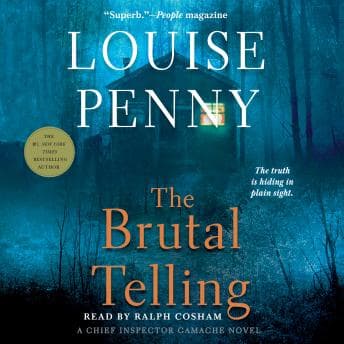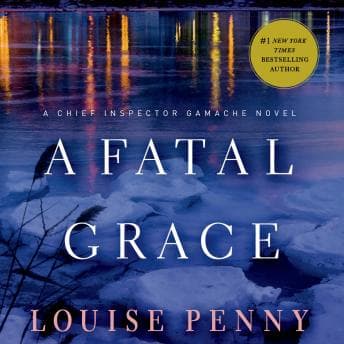

So here's the thing about cozy mysteries: they're supposed to be, well, cozy. Warm sweaters and tea and maybe a body or two, but nothing that'll keep you up at night. Louise Penny gets this. She understands that horror isn't about gore—it's about dread. And electrocuting someone in the middle of a frozen lake while an entire village watches a curling tournament? That's dread dressed up in a parka.
I listened to this during a particularly brutal Oregon winter, which felt appropriate. My branch library was practically empty, the rain was doing that sideways thing it does, and Ralph Cosham's voice was the only thing keeping me company during my closing shift. Shirley (my cat, not Jackson, though I'd argue Penny channels some of that same slow-building unease) was unimpressed by my occasional gasps. She's heard worse from my podcast recording sessions.
The Voice That Haunts Three Pines
Ralph Cosham. I need to talk about Ralph Cosham.
Look, I've listened to hundreds of audiobooks at this point—occupational hazard of hosting a horror podcast and working in a library. Most narrators are fine. Competent. They read the words and don't mispronounce things and you forget about them the moment you hit stop. The narrator in Camp of the Dog had that same quality—someone who understood that atmosphere matters as much as plot. Cosham isn't that. Cosham commits.
His French-Canadian accent isn't performative or showy. It's lived-in. When Gamache speaks, there's this warmth that cuts through the cold of the setting, and you understand immediately why people trust this man with their darkest secrets. The way Cosham handles the interplay between Francophone and Anglo characters—the subtle tensions, the cultural friction—it never feels like a caricature. It feels like overhearing actual conversations in an actual Quebec village.
And the pacing. Oh, the pacing. Cosham knows when to slow down, when to let silence do the work. There's a moment—I won't spoil it—where a revelation lands, and he just... pauses. Lets it breathe. That's not in the script. That's a narrator who understands that sometimes the space between words matters more than the words themselves.
Murder as Social Commentary (But Make It Cozy)
CC de Poitiers is the kind of victim mystery writers dream about. Nobody liked her. Not her husband, not her lover, not her daughter, not a single soul in Three Pines. She's awful in that specific, calculated way that makes you think the author had someone very particular in mind when she created her. (We've all known a CC, haven't we?)
But here's where Penny does something clever. She doesn't let you off the hook with simple hatred. As Gamache investigates, you start to see the cracks in CC's armor, the reasons behind the cruelty. It doesn't excuse her—nothing could—but it complicates your feelings. And complicated feelings are where the best mysteries live.
The murder method itself is gloriously theatrical. Electrocution on a frozen lake, in front of witnesses, and somehow no one saw anything? It's the kind of locked-room-adjacent puzzle that would feel gimmicky in lesser hands. Penny makes it work because she's less interested in the how than the why. President Is Missing took a different approach—all how, minimal why—which worked for that kind of thriller but left me cold compared to this. The village of Three Pines is as much a character as Gamache, and its secrets run deep.
The Slow Burn That Earns Its Warmth
I'll be honest—if you need your mysteries fast and furious, this isn't your book. Penny takes her time. She lingers on character moments, on the texture of village life, on the way winter light hits snow. Some listeners might find this slow. I found it atmospheric as hell.
This is the kind of book where you notice the chapter breaks because you've been so absorbed you forgot you were listening to something with structure. The 10-plus hours flew by, which rarely happens for me with mysteries. Usually I'm checking how much time is left. Here, I was disappointed when it ended.
The content warnings mention violence and sexual content, but honestly? It's tame compared to most thrillers. The violence is more implied than graphic, and the "sexual content" is... present but not explicit. If you're coming from hard-boiled crime fiction, this will feel like a warm bath in comparison.
Who Gets an Invitation to Three Pines (And Who Should Stay Home)
If you're a fan of character-driven crime fiction, this is essential listening. If you appreciate narrators who elevate source material rather than just reading it, Cosham is a clinic in how it's done. If you want a mystery that respects your intelligence while also giving you genuine warmth—yes, even while discussing murder—Three Pines is waiting for you.
Skip if you need constant action or if slow-building plots make you antsy. This is a simmer, not a boil.
Closing the Library on This One
My podcast listeners are going to love this recommendation. It's exactly the kind of horror-adjacent, atmosphere-heavy mystery that proves you don't need jump scares or gore to create genuine unease. Sometimes the scariest thing is a village full of people who all had reason to kill—and the realization that you might have done the same.