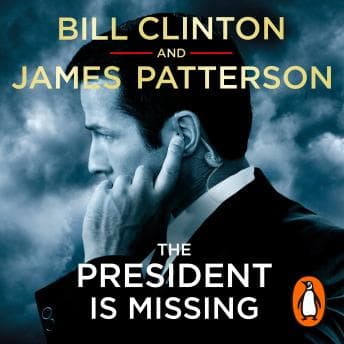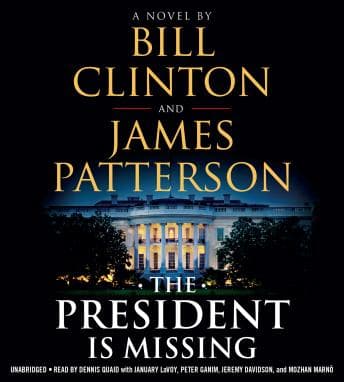

I should be grading papers on cognitive dissonance right now. Instead, I've spent the last three days obsessively listening to Bill Clinton and James Patterson's literary love child while aggressively chopping vegetables for a curry I probably won't finish.
(My therapist says this is "displacement." I call it research.)
Here's the thing about The President Is Missing. It is technically a thriller, yes. But psychologically? It's a fascinating, high-budget exercise in wish fulfillment. The literary equivalent of winning an argument in the shower three years after it happened. And honestly? I kind of loved it.
The "Hero Complex" on Display
Let's be real for a second. You don't pick up this book for the prose. You pick it up to see what happens when a former Commander-in-Chief teams up with the guy who writes books faster than most people read tweets. The result is... weirdly compelling.
The protagonist, President Jonathan Duncan, is basically Captain America in a suit. Noble, misunderstood, secretly smarter than his entire Cabinet. From a behavioral standpoint, it's a textbook Mary Sue situation—or I guess, a "Gary Stu." But because Patterson knows exactly how to trigger our dopamine receptors with short chapters and constant cliffhangers, you buy it.
It reminds me of the Bollywood movies my mother used to force me to watch on Sundays. Is the plot ridiculous? Absolutely. Is the hero unrealistically capable of solving complex geopolitical crises with a single speech and a gun? One hundred percent. But do you keep watching? Yes. Because the human brain loves a competence porn narrative. We crave the idea that someone is in charge and knows what they're doing.
(Especially these days. Don't get me started.)
The Dennis Quaid Dilemma
Okay, we need to talk about the audio production. It's billed as a high-octane performance, and in some ways, it is. Dennis Quaid voices President Duncan, and he brings this gravelly, tired-but-tough gravitas that really works for the internal monologues. He sounds like a President. He sounds like a guy who hasn't slept since the mid-90s.
But—and this is a big "but"—his character voices.
Oh, boy.
Look, I study human behavior. I listen to voices all day. When Quaid attempts a female voice, or a foreign accent, it's not just bad. It's distracting. It yanks you right out of the immersion. Almost caricature-like. At one point, I actually paused the track while jogging along the Charles River because I was laughing so hard at an accent that sounded like a bad SNL sketch.
Fortunately, the rest of the cast—January LaVoy, specifically—does some heavy lifting to save the day. The production feels more like a radio play than a standard audiobook, with sound effects and music. It's slick. It moves fast. It covers up the cracks in the plot with sheer volume and momentum. Deception Point uses that same strategy—breakneck pacing to distract you from the fact that the villain's motivations don't entirely hold up under scrutiny.
Why It (Mostly) Works
The most interesting part for me wasn't the cyber-terror plot (which is terrifyingly plausible, by the way). It was the procedural details. You can tell which parts Clinton wrote. There's a specificity to the descriptions of the White House, the secret tunnels, the way the Secret Service moves, that feels incredibly grounded.
It creates this weird cognitive dissonance: the setting is hyper-realistic, but the action is pure Hollywood.
And then there's the ending. I won't spoil it, but there's a speech. A long speech. It feels like Clinton just really wanted to get some things off his chest. From a narrative perspective, it kills the pacing. But as a window into the author's psyche? Fascinating. It's preachy, it's earnest, and it's exactly what you'd expect.
Who Should Listen (And Who Should Skip)
Perfect for long commutes or—in my case—avoiding the crushing reality of academic deadlines. If you need literary nuance or can't tolerate questionable accents, skip it. But if you want a competence-fantasy thriller with insider White House details? This delivers.
Final Analysis
Is this high literature? No. My dissertation committee would roll their eyes so hard they'd detach retinas. But is it a fun ride? Yeah, it is.
If you can get past Quaid's questionable accents and the sheer ego of the premise, it's a solid thriller. Just don't expect a nuanced study of the human condition. Expect explosions, speeches, and a President who is definitely, absolutely not based on any real person. (Wink.)