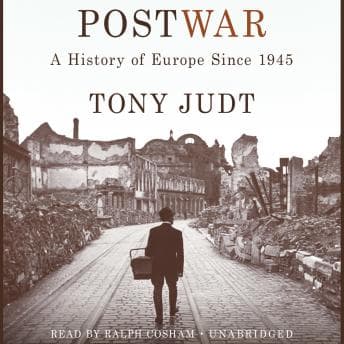

"Europe was not born in Auschwitz... but it was in the shadow of Auschwitz that Europe's statesmen elected to build a better continent."
That line hit me somewhere around hour 30, and I had to pull the truck over. Not because I was emotional - okay, maybe a little - but because it crystallized what Tony Judt had been building across hundreds of pages of dense, brilliant history. I'd been driving back from a client site in San Antonio, Ranger asleep in the back seat, and suddenly this book about postwar European reconstruction felt like it was describing every stabilization operation I'd ever been part of. Different scale. Same fundamental questions about what you do with rubble.
Forty-Three Hours Is a Deployment, Not a Listen
Let me cut to the chase: this is a 43-hour commitment. That's not a book - that's a relationship. I started it on a Monday and didn't finish until nearly three weeks later, listening during every windshield hour, every morning run with Ranger, every late night when Linda was already asleep and I was cleaning up the kitchen.
Worth it? Absolutely. But you need to know what you're signing up for.
Judt covers thirty-four nations across sixty years - from the immediate postwar rubble of 1945 through the EU expansion debates of the early 2000s. What makes this different from a hundred other European history books is scope combined with opinion. Judt doesn't just catalog events. He argues. He'll spend a chapter laying out how France's obsession with national grandeur under de Gaulle created specific policy distortions, then pivot to show how East Germany's surveillance state manufactured a particular kind of social corrosion that West Germans couldn't understand even after reunification. Every country gets its turn in the spotlight, and the smaller nations - Belgium's linguistic tensions, Austria's selective amnesia about its Nazi past, the particular tragedy of Yugoslavia - get treatment that most histories skip entirely.
I've briefed senior officers on geopolitical situations with far less depth than what Judt provides for, say, the Italian political crisis of the 1970s or the British coal miners' strike. The man clearly did his homework - and then did it again in five more languages.
When a British Voice Becomes Your History Professor
Ralph Cosham. What a narrator. His British accent gives the whole production an authority that fits the material perfectly - like having a Oxford don explain the Marshall Plan while you're stuck in I-35 traffic. His facility with the foreign names and phrases is genuinely impressive. French politicians, Czech dissidents, German economists - he moves between languages with a smoothness that kept me from getting tripped up on pronunciation.
There's one caveat: some of the foreign names sound like they were overdubbed after the fact, and you can hear the edit. It's not terrible, but it's noticeable if you're paying attention. A minor thing across 43 hours.
What Cosham really nails is pacing. Judt's prose shifts between analytical passages and almost journalistic storytelling, and Cosham adjusts his delivery accordingly. During the drier economic policy sections (and there are some - the European Monetary System chapters tested my commitment), his steady tone keeps you anchored. During the more dramatic passages - the fall of the Berlin Wall, the Srebrenica massacre - he lets the material breathe without getting theatrical. I listened at 1.25x and it felt natural.
The Parts That Hit Like an IED
Here's where my background colors things. Judt's treatment of how nations process collective trauma - the lies they tell themselves, the convenient amnesia, the decades it takes to acknowledge what actually happened - that's not academic to me. I watched Iraq try to figure out what to do with Ba'athist bureaucrats. De-Ba'athification was basically denazification with worse planning. Reading Judt's account of how postwar Europe handled (and mishandled) its collaborators, its war criminals, its millions of displaced people - I've seen this scenario play out in real life, just with different flags and different sand.
The sections on Yugoslavia in the 1990s are particularly brutal. Judt doesn't flinch from European failure there, and he shouldn't. I had buddies who deployed to Bosnia. The political paralysis he describes - the way Western European leaders convinced themselves it wasn't their problem until it very much was - reads like an after-action report on institutional failure.
Who Should Saddle Up (And Who Should Stand Down)
This is not background listening. Don't even try. If you want something for the gym or while you're answering emails, pick literally anything else. This demands focus - the kind of focused attention you'd give a complex operational briefing where missing one detail means you'll be lost for the next twenty minutes.
But if you're the type who wants to actually understand why Europe looks the way it does today - why the EU exists, why Eastern Europe carries specific grudges, why French and German politics follow their particular patterns - this is the book. Period. It's the most comprehensive single-volume treatment I've encountered, and Cosham's narration makes 43 hours manageable in a way that staring at 900 pages might not be.
History buffs, policy wonks, anyone in security or foreign affairs work - you need this in your library. I'd put American Religious History in the same category - another dense, argumentative survey that rewards the kind of focused attention most people aren't willing to give. Casual listeners looking for a weekend diversion? Hard pass.
Mission Debrief
Three weeks with Tony Judt in my ears, and I came out the other side smarter. That's the highest compliment I can pay a history book. Ranger slept through most of it, but he perked up during the Cold War chapters - probably the tension in Cosham's voice. The author clearly did his homework, and then wrote it up with a clarity and conviction that most historians can't touch. Worth your time? If you've got the discipline for 43 hours of serious history, this is mission accomplished.







![Steve Jobs [unabridged audiobook] audiobook cover](/_next/image?url=https%3A%2F%2Fcovers.audiobooks.com%2Fimages%2Fcovers%2Ffull%2F9788499923406.jpg&w=1920&q=75)