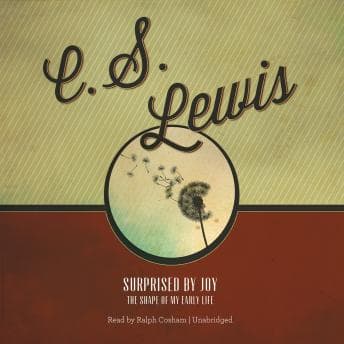

I was working on a logo redesign for a local coffee shop - the kind of project that requires zero brain cells and maximum vibes - when Ralph Cosham's voice started painting C.S. Lewis's childhood in my headphones. And honestly? I wasn't prepared for how much this book would wreck me.
Look, I picked this up because I've been on a memoir kick lately, and something about Lewis's title grabbed me. "Surprised by Joy." That's the kind of phrase that makes my heart do a little flip. But I should warn you: this isn't the warm, fuzzy spiritual journey I expected. It's sharper. More intellectual. And weirdly, that made the emotional moments hit even harder.
The Voice That Carried Me Through
Ralph Cosham. I didn't know his name before this, but now I'm adding him to my mental list of narrators I'd follow anywhere. His voice has this quality - warm but not saccharine, clear but not clinical. He reads Lewis like he genuinely loves the material, which... yeah, that matters so much to me. When Lewis describes his childhood experiences with what he calls "Joy" - these fleeting moments of intense longing for something beyond - Cosham's delivery made me stop designing entirely. Just sat there with my stylus hovering, feeling things.
He does these subtle character voices too, nothing over-the-top, just enough differentiation that you can tell who's speaking. The schoolmasters, Lewis's brother Warnie, his father - they all feel distinct without becoming a performance. It's narration that serves the story rather than showing off, and I respect that so much.
Where Lewis Made Me Ugly-Cry (Yes, Really)
Okay so here's the thing about this book - it's not conventionally emotional. Lewis writes with this formal, almost academic style that can feel distancing at first. I definitely caught myself reaching for my phone to look up words a few times. (Abuela would have laughed at me - she always said I was too impatient for old books.)
But then Lewis starts describing his mother's death when he was just a boy, and the way his world collapsed afterward, and I was crying into my keyboard at 2 PM on a Tuesday. The formality of his language somehow makes it worse? Like he's trying so hard to be rational about something that fundamentally broke him. My heart. MY HEART.
And the concept of "Joy" itself - this aching, beautiful longing for something you can't name - that hit different. Lewis chases this feeling through his whole life, through atheism and philosophy and war, and when he finally understands what he was reaching for... I don't know. Even if you're not religious, there's something universally human about wanting to touch something transcendent.
The Slow Burn That Requires Patience
I'm not gonna lie to you - this book requires some patience. Lewis takes his time. He goes deep into his schooldays (brutal, honestly), his experiences in the trenches of World War I, his intellectual wrestling matches at Oxford. Some of it dragged for me, especially the detailed accounts of his various teachers and schools. I zoned out during a few of those stretches, had to rewind.
And the ending? It does feel a bit rushed. After all that buildup, all that searching, the actual moment of conversion gets relatively brief treatment. I wanted more. I wanted Lewis to sit with me in that moment longer. It's like he spent the whole book cooking an elaborate meal and then served dessert in a to-go container. Their Eyes Were Watching God does something similar—Hurston rushes through Janie's final transformation, but the path there is so luminous you don't even care.
But here's the thing - the journey itself is so rich that I almost forgive the destination feeling abbreviated. Almost.
Who Will Love This (And Who Should Skip)
This is a rainy Sunday book. A "curl up with tea and let someone brilliant talk to you about the big questions" book. If you love Lewis's other work, if you've ever wondered how a fierce intellect comes to faith, if you're drawn to memoirs that don't flinch from pain - you'll find something here. But if you need fast pacing or modern, casual prose? This probably isn't your book. The language is formal, the pace is contemplative, and Lewis assumes you're willing to work a little for the payoff.
Cosham's narration makes it all more accessible, though. Seriously, I don't think I could have read this in print - his voice carried me through the denser passages. The vibes are immaculate, in that quiet, thoughtful way that memoirs should be.
Finding Your Way Home
Abuela would have loved this one. She always said the best stories are about people finding their way home. And that's exactly what Lewis does here - wanders through grief and doubt and longing until he finally arrives somewhere that feels like belonging. I'm still thinking about it, days later. Still feeling it.