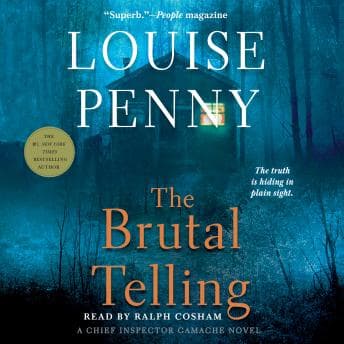

I started this audiobook during a morning jog through Cambridge and ended up standing frozen on a bridge for ten minutes because I couldn't stop listening. My therapist would probably have something to say about that level of absorption, but here we are.
Louise Penny does something I rarely see in mystery fiction—she creates a detective who actually behaves like a psychologically coherent human being. Chief Inspector Gamache exhibits what we'd call secure attachment style. He's confident without arrogance, curious without obsession, and leads his team with genuine emotional intelligence. In a genre saturated with damaged, brooding detectives who treat everyone like suspects (including themselves), Gamache is refreshing. Almost suspiciously so. I kept waiting for the dark backstory reveal that would explain some hidden dysfunction. It never came. The man is just... well-adjusted? The research actually shows that effective leaders often are, but fiction rarely believes it.
Three Pines as Petri Dish
The village isn't just a setting—it's a controlled experiment. Penny populates this tiny Quebec hamlet with the kind of eccentric personalities that small towns inevitably produce when people have too much time and too few strangers. The victim, Jane Neal, was clearly beloved by everyone, which immediately made me suspicious of everyone. (Don't tell my students I approach fictional murders like case studies, but I absolutely do.)
What makes this character-driven mystery work is Penny's understanding that motives are rarely simple. The townspeople aren't hiding obvious secrets—they're hiding the complicated, messy truths that real humans hide. Shame. Jealousy. Love that curdled into something else. Gamache asks questions like a good therapist: open-ended, non-judgmental, genuinely curious about the answer.
The pacing is deliberate. Some would say slow. I'd say it mirrors how actual grief and suspicion unfold in close communities—not with dramatic confrontations, but with small revelations over coffee and awkward silences at dinner parties. If you need a body every fifty pages, this isn't your book. But if you want to understand why someone might kill a kind old woman in the woods? Stay.
Ralph Cosham's Dignified Warmth
Here's where I have to be honest about something that initially threw me. Ralph Cosham has a distinctly British delivery, and Three Pines is in Quebec. Canada. Not England. My brain kept flagging this as incongruent for the first hour or so.
But then something shifted. Cosham's voice has this dignified warmth that just... fits Gamache's character. The restraint in his delivery matches the inspector's measured approach to investigation. When Gamache sits with a grieving friend or gently corners a suspect, Cosham's pacing slows almost imperceptibly. He nails it. The character voices are distinct without being cartoonish—you can tell who's speaking even without dialogue tags, which is harder than it sounds.
I found myself asking: why does the British accent work here when it shouldn't? I think it's because Cosham isn't performing "British"—he's performing "educated, thoughtful, slightly formal." And that tracks for Gamache, who quotes poetry and treats suspects with courtesy even when he knows they're lying. The accent becomes part of the character rather than a distraction from it.
That said, if accent authenticity is a dealbreaker for you, you might struggle. Some listeners found the narration monotonous, and I can see that—Cosham doesn't do dramatic vocal fireworks. But I'd argue the restraint serves the material. This is a cozy mystery with dark undercurrents, not a thriller.
Who Should Listen (And Who Should Walk Away)
If you grew up on Agatha Christie like I did (thanks, Maa, for the endless paperbacks), this will feel like coming home. That same cozy-mystery-with-depth vibe runs through Circular Staircase, though it leans harder into the classic formula. Penny clearly studied the masters—the closed community, the seemingly impossible crime, the detective who sees what others miss. But she adds psychological depth that Christie rarely bothered with.
Perfect for long commutes or weekend cooking sessions. I made an entire biryani during the middle section and didn't miss a beat. The production is clean, Cosham's voice is easy on the ears for extended listening, and the plot doesn't require intense concentration to follow.
Skip if you want action. Skip if slow burns frustrate you. Skip if you can't get past the British-narrator-Canadian-setting thing.
Case Closed (For Now)
If you want a mystery that respects both your intelligence and your emotions? If you want characters who feel like people you might actually know? This one rewards patience. I'm already eyeing the next book in the series.
(And yes, I know I said I'd stop starting new series. But here we are.)